Field note

GPT-5's unified model has a hidden token tax

GPT-5 ships as one model with an automatic router that decides how hard to think for you. Convenient, until you watch a simple question quietly trigger a web search, a page read, and a reasoning chain you never asked for - and burn through a capped Plus plan in an afternoon.

Aug 8, 2025 · Navin Agrawal · AI systems · 2 min read

GPT-5's unified model has a hidden token tax

Visual brief

Visual brief

GPT-5's unified model has a hidden token tax

As of August 2025

GPT-5 launched on August 7, 2025 as a unified model: one endpoint, an automatic router behind it that picks fast answers or deeper reasoning for you. The pitch is simplicity. The catch is that the automatic behaviors run whether you want them or not.

On a metered Plus plan, that changes the math. The router can decide a throwaway question deserves a web search, a page read, and a long reasoning chain, and you pay for all of it.

Launch

Aug 7, 2025

GPT-5 launches as a unified model with an automatic router that picks how hard to think (OpenAI).

Plus cap

80 / 3 hr

the GPT-5 message cap for ChatGPT Plus at launch, then a drop to a smaller model.

Per question

~14,000

tokens the author estimates one simple question can consume once auto search and reasoning fire.

Where the tokens go

By the author’s worked example, a 500-token question can quietly pull in an automatic web search, a few thousand tokens of page analysis, and a long background-reasoning chain before it ever answers - roughly 14,000 tokens for one exchange. Ask a follow-up and the model rereads the whole thread and does it again. The numbers are illustrative, but the shape is real: most of the spend is invisible.

Why it matters on Plus

Plus is a metered plan. When the router decides every question deserves the full treatment, a budget that used to stretch across a day of questions gets consumed far faster. You are paying for search, analysis, and reasoning you did not request, on questions that did not need them.
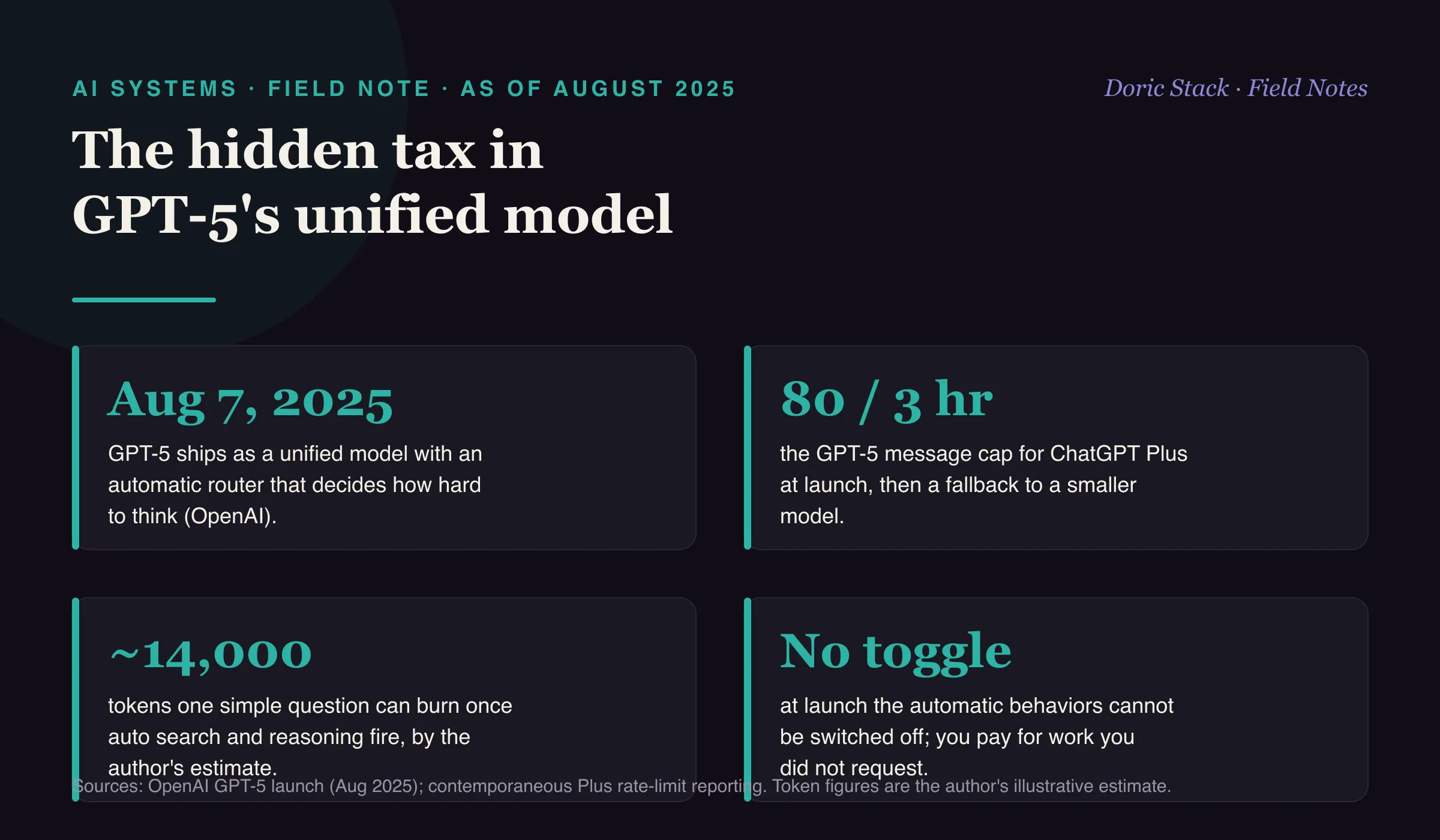
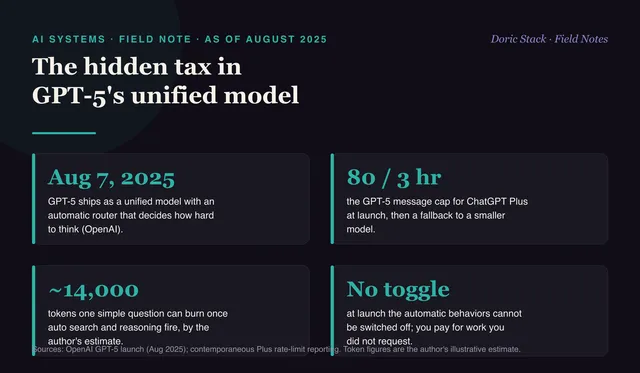
The hidden token tax in GPT-5's unified model (as of August 2025): GPT-5 launched August 7, 2025 as a unified model with an automatic router; ChatGPT Plus capped GPT-5 at 80 messages every three hours at launch before dropping to a smaller model; the author estimates one simple question can consume around 14,000 tokens once auto search and reasoning fire; and at launch the automatic behaviors cannot be switched off, so you pay for work you did not request.
The convenience of one model that always does the most is the vendor's convenience, and the user's bill.
Sometimes the best AI strategy is demanding the choice to use less AI when you do not need the full treatment.
Was this useful?

Choose once.

Related Posts

View All Posts »
The chip ban forced China to build smarter AI

The chip ban forced China to build smarter AI

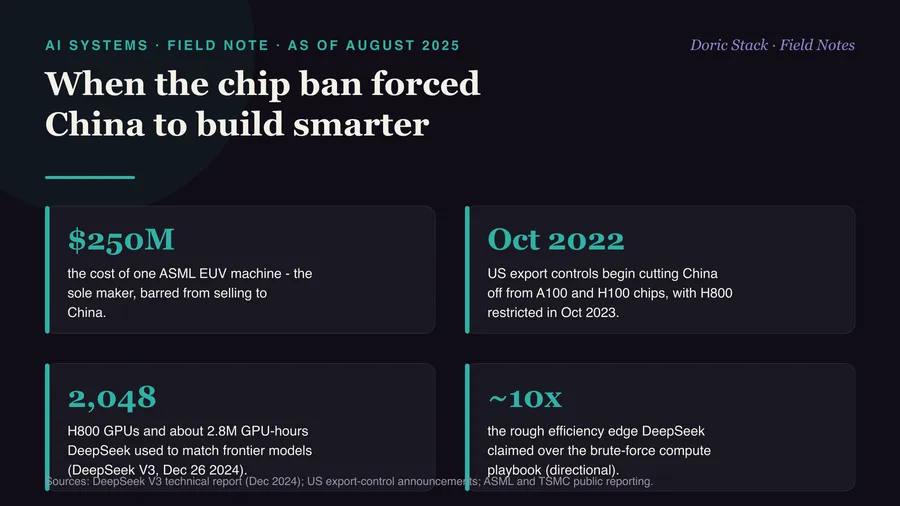
The AI race everyone watches is the application layer. The one that decides it runs four layers down, in chip design, fabs, and export controls. When the US cut China off from the best GPUs, DeepSeek answered with efficiency instead of scale - and that is the lesson worth keeping.

Most AI agents never reach production. Payments is where that gets expensive

Most AI agents never reach production. Payments is where that gets expensive

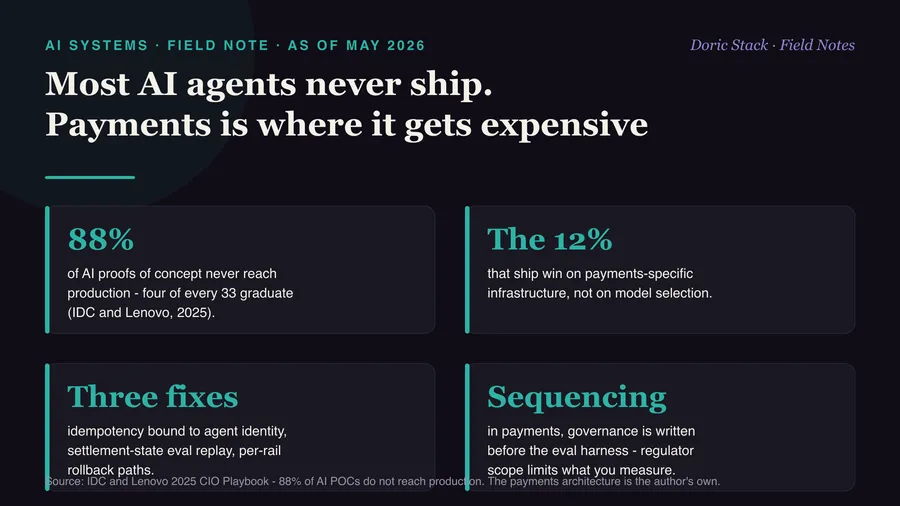
The widely cited figure is that 88 percent of AI proofs of concept never reach production. Agentic payments inherit that gap, and the teams that cross it are not winning on model selection. They are winning on payments-specific infrastructure that makes an agent idempotent, governable, and rollback-safe at the rail boundary.

Multi-model is the new multi-rail

Multi-model is the new multi-rail

Every payment system routes across multiple rails - ACH fails, traffic moves to wire, and wire is dear for small amounts so you route to RTP. Most AI systems still call one model and hope it stays up. The LLM gateway is the same routing engine payments has run for decades, and it needs the same three things to count.

Agents do the wiring, architects carry the tradeoffs

Agents do the wiring, architects carry the tradeoffs

AI agents are arriving faster than most banking career ladders can adapt, and the market is already rewarding people who work with them. The career moat was never wiring up another API call. It is the judgment calls agents cannot own - which rail to trust, how much latency to spend, who the regulator will be.