Field note

Agents do the wiring, architects carry the tradeoffs

AI agents are arriving faster than most banking career ladders can adapt, and the market is already rewarding people who work with them. The career moat was never wiring up another API call. It is the judgment calls agents cannot own - which rail to trust, how much latency to spend, who the regulator will be.

Dec 1, 2025 · Navin Agrawal · AI systems · 2 min read

Agents do the wiring, architects carry the tradeoffs

Visual brief

Visual brief

Agents do the wiring, architects carry the tradeoffs

As of December 2025

AI agents are arriving faster than most banking career ladders can adapt, and the market has noticed. The risk is chasing the buzzword without understanding what actually changes in a serious payment system.

Working with agents is now among the fastest-growing AI skills professionals are adding. The question is what the skill is actually for, because the part that matters in payments is not the part an agent does.

Skill demand

Fastest-growing

AI agents is among the fastest-growing AI skills on LinkedIn (AI Labor Market Update, Sep 2025).

In production

Moneybot

Cash App's AI money assistant launched November 2025, with every action user-confirmed.

Core operations

Eurobank

agentic AI moving into core operations with Fairfax, EY, and Microsoft (November 2025).

What agents already do

You can see the shape in production. Cash App’s Moneybot, launched in November 2025, helps people manage spending, set savings targets, and place trades, with every action confirmed by the user. Eurobank announced a program with Fairfax, EY, and Microsoft to move agentic AI into core operations, supporting staff on routine analysis. Agents explore options, replay scenarios, and keep the orchestration glue running.

What they do not carry

In the payment work I have seen, the career moat was never wiring up another API call. It lived in the judgment: which rail to trust for this use case, how much latency budget to spend on risk checks, what happens to liquidity if a route fails at 2:17 AM, and which regulator will care most when it goes wrong. An agent can help you reason about those. It does not carry the accountability for the call.
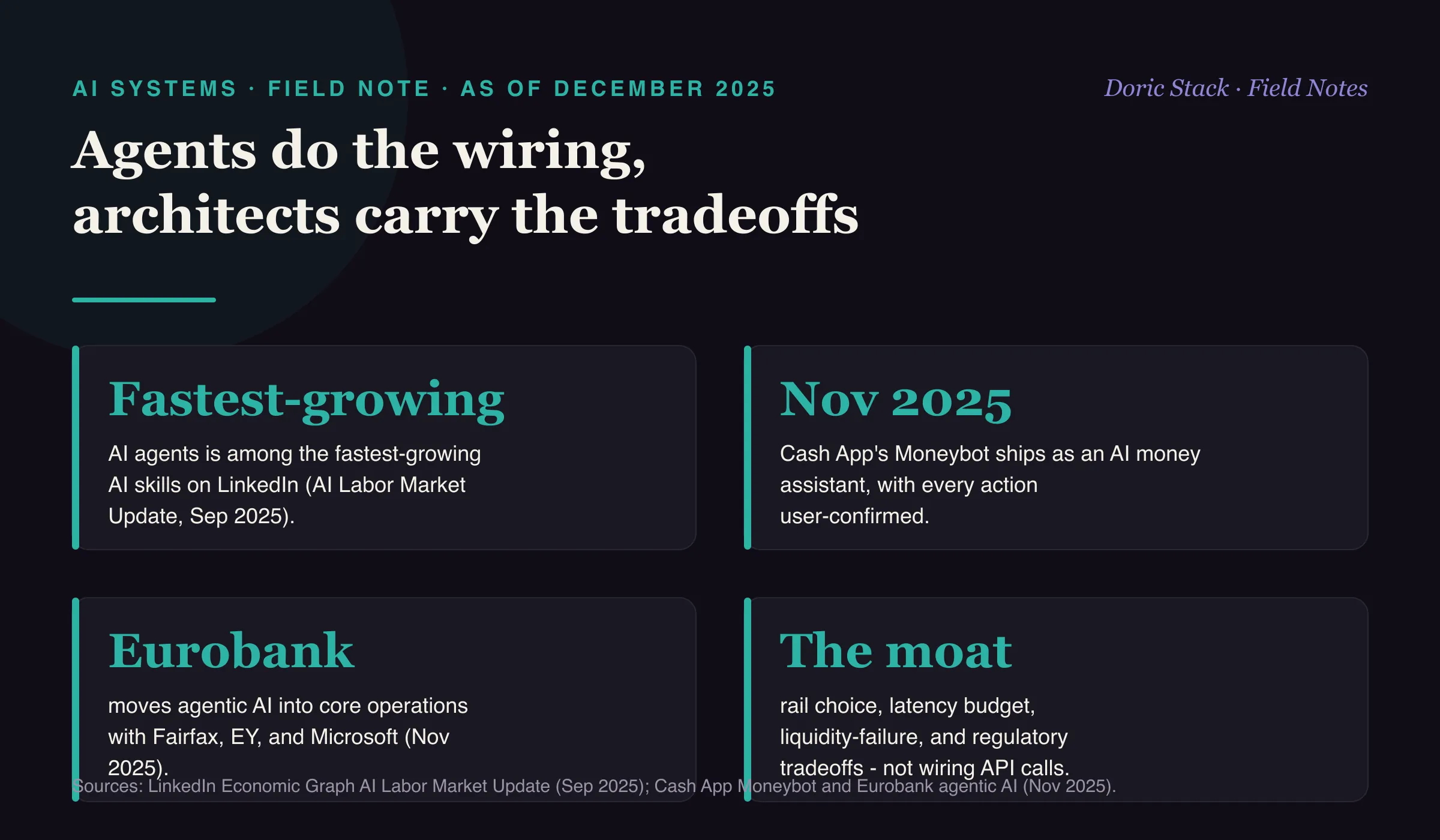
Agents do the wiring, architects carry the tradeoffs (as of December 2025): AI agents is among the fastest-growing AI skills on LinkedIn per the September 2025 AI Labor Market Update; Cash App's Moneybot launched in November 2025 as an AI money assistant with every action user-confirmed; Eurobank moved agentic AI into core operations with Fairfax, EY, and Microsoft in November 2025; and the durable career moat is rail choice, latency budget, liquidity-failure handling, and regulatory tradeoffs, not wiring API calls.
Let the agent do the mechanical work. The judgment that survives regulators and outages is the part that stays human.
The architects who redraw their own job descriptions around this division of labor will direct the agents, not compete with them.
Was this useful?

Choose once.

Related Posts

View All Posts »
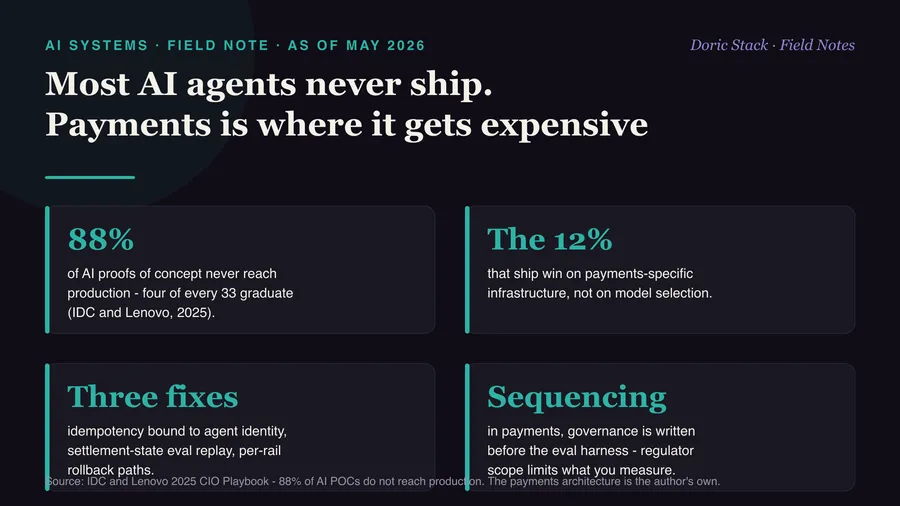
Most AI agents never reach production. Payments is where that gets expensive

Most AI agents never reach production. Payments is where that gets expensive

The widely cited figure is that 88 percent of AI proofs of concept never reach production. Agentic payments inherit that gap, and the teams that cross it are not winning on model selection. They are winning on payments-specific infrastructure that makes an agent idempotent, governable, and rollback-safe at the rail boundary.

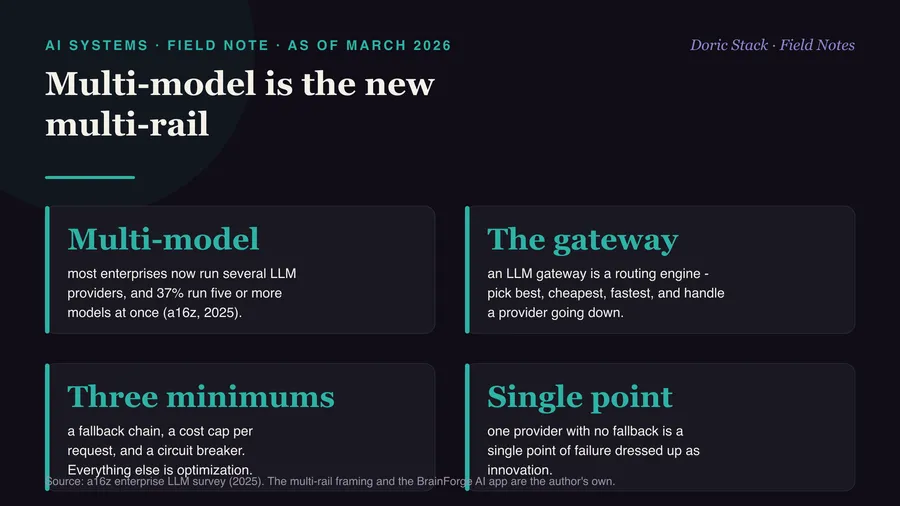
Multi-model is the new multi-rail

Multi-model is the new multi-rail

Every payment system routes across multiple rails - ACH fails, traffic moves to wire, and wire is dear for small amounts so you route to RTP. Most AI systems still call one model and hope it stays up. The LLM gateway is the same routing engine payments has run for decades, and it needs the same three things to count.

AI agents can buy now, and fraud systems were not built for it

AI agents can buy now, and fraud systems were not built for it

Stripe, OpenAI, and Google shipped protocols that let AI agents complete purchases inside a conversation. The rails are already fast enough. The problem is that fraud detection was architected around a human clicking buy on a trusted surface, and agents break that assumption.

DeepSeek-OCR reads documents as compressed vision tokens

DeepSeek-OCR reads documents as compressed vision tokens

Payments runs on documents - checks, wires, invoices, KYC files - and the OCR that reads them chokes on handwriting and damage. DeepSeek-OCR processes a page as roughly 100 visual tokens instead of a thousand text tokens, and it is open source. The headline accuracy comes with a compression ceiling worth knowing.