Field note

AI agents can buy now, and fraud systems were not built for it

Stripe, OpenAI, and Google shipped protocols that let AI agents complete purchases inside a conversation. The rails are already fast enough. The problem is that fraud detection was architected around a human clicking buy on a trusted surface, and agents break that assumption.

Nov 18, 2025 · Navin Agrawal · AI systems · 3 min read

AI agents can buy now, and fraud systems were not built for it

Visual brief

Visual brief

AI agents can buy now, and fraud systems were not built for it

As of November 2025

ChatGPT can buy things for you now, and your fraud systems were architected for a world where a human clicks buy on a trusted surface. Agents break that assumption.

This is a hard break, not a gradual evolution. The rails are already fast enough - RTP and FedNow settle in real time. The gap is in fraud prevention, which was built around human behavior and a present buyer.

The protocols arrived in a cluster. On September 16, 2025, Google announced its Agent Payments Protocol, backed by 60-plus payments and technology partners including Mastercard, American Express, and PayPal. On September 29, Stripe and OpenAI launched the Agentic Commerce Protocol, letting ChatGPT’s more than 800 million weekly users complete a purchase without leaving the conversation. On October 28, PayPal formalized its support for ChatGPT checkout on top of its earlier AP2 involvement. Two rival approaches, both open source, both moving fast.
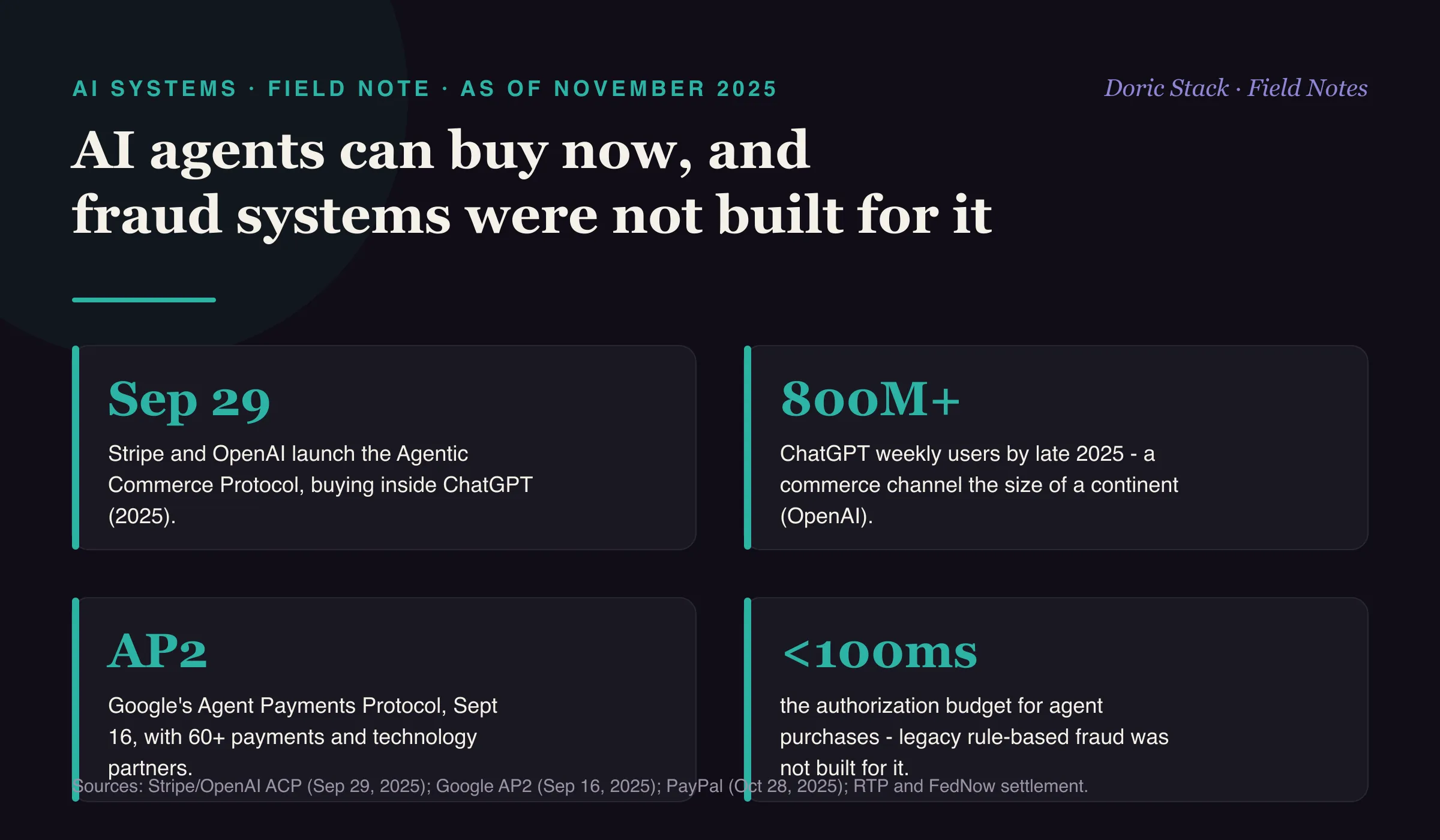
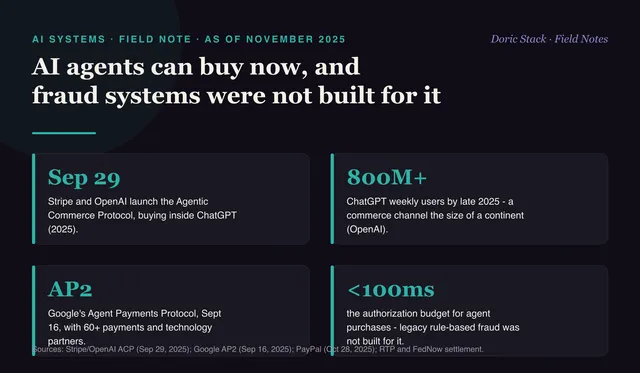
AI agents can buy now and fraud systems were not built for it (as of November 2025): Stripe and OpenAI launched the Agentic Commerce Protocol on September 29, 2025, letting users buy inside ChatGPT; ChatGPT had more than 800 million weekly users by late 2025; Google announced its Agent Payments Protocol on September 16 with 60-plus payments and technology partners; and agent purchases need authorization in under 100 milliseconds, a budget legacy rule-based fraud checks were never built for.
Two open protocols, real-time rails, and a fraud stack that assumed a human was present. The mismatch is the work.

Stripe + OpenAI

Sep 29

the Agentic Commerce Protocol launches, letting users buy inside ChatGPT (2025).

Google

AP2

the Agent Payments Protocol, announced Sept 16, with 60+ payments and technology partners.

Auth budget

<100ms

the window agent purchases need - legacy rule-based fraud checks were not built for it.

What the protocols add

Stripe’s Agentic Commerce Protocol uses Shared Payment Tokens scoped to a specific merchant and amount. Google’s AP2 uses cryptographically signed mandates that chain intent to cart to payment, leaving a tamper-evident audit trail.

What the fraud stack has to relearn

The assumptions underneath the old controls no longer hold. Multi-factor authentication means little when the customer has genuinely authorized an agent to transact. Behavioral analytics trained on human browsing find nothing familiar in an agent’s purchasing pattern. Risk scoring built on session analysis has to adapt to delegated purchases where the buyer is not present at the moment of the transaction. The protocols give you scoped tokens and signed mandates to work with, but the fraud models, the risk scoring, and the authorization flow all need re-architecting around agent behavior.
Was this useful?

Choose once.

Related Posts

View All Posts »
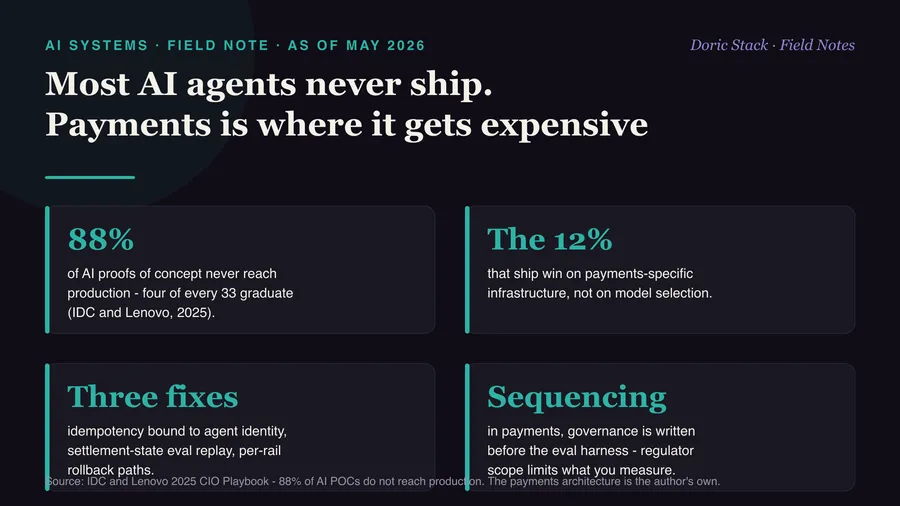
Most AI agents never reach production. Payments is where that gets expensive

Most AI agents never reach production. Payments is where that gets expensive

The widely cited figure is that 88 percent of AI proofs of concept never reach production. Agentic payments inherit that gap, and the teams that cross it are not winning on model selection. They are winning on payments-specific infrastructure that makes an agent idempotent, governable, and rollback-safe at the rail boundary.

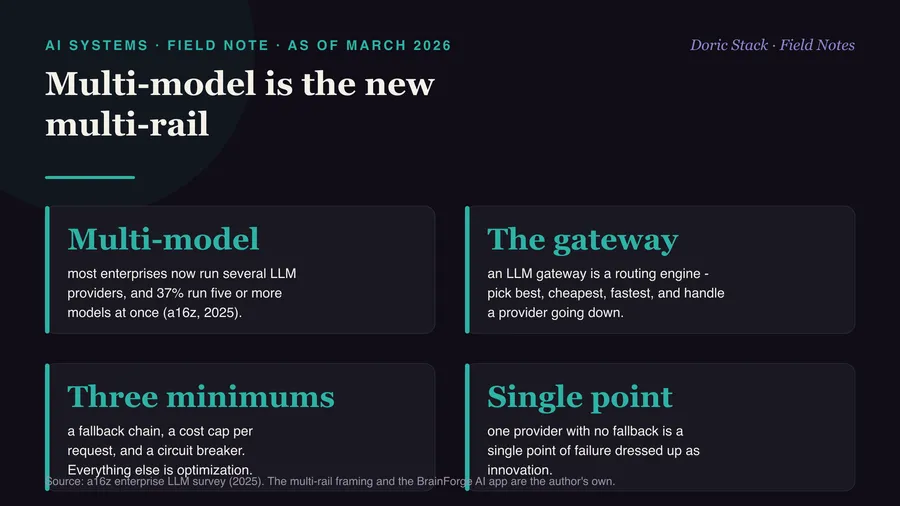
Multi-model is the new multi-rail

Multi-model is the new multi-rail

Every payment system routes across multiple rails - ACH fails, traffic moves to wire, and wire is dear for small amounts so you route to RTP. Most AI systems still call one model and hope it stays up. The LLM gateway is the same routing engine payments has run for decades, and it needs the same three things to count.

Agents do the wiring, architects carry the tradeoffs

Agents do the wiring, architects carry the tradeoffs

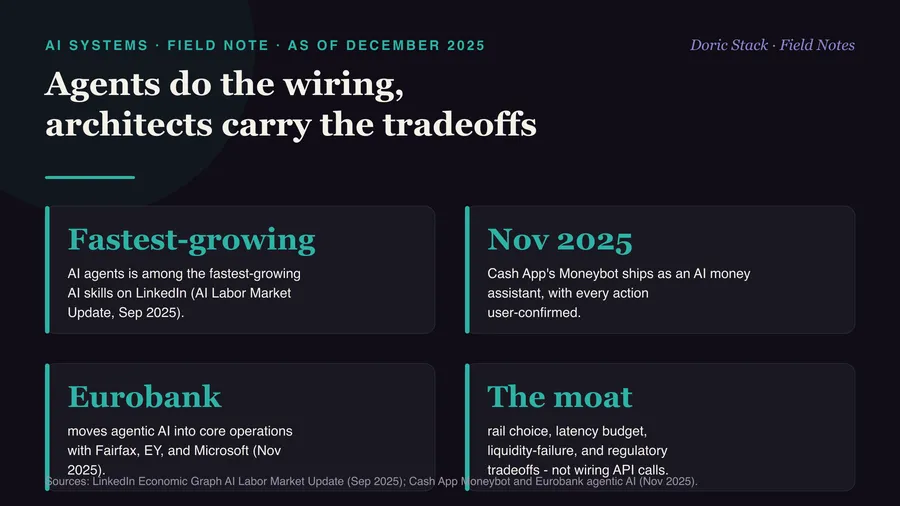
AI agents are arriving faster than most banking career ladders can adapt, and the market is already rewarding people who work with them. The career moat was never wiring up another API call. It is the judgment calls agents cannot own - which rail to trust, how much latency to spend, who the regulator will be.

DeepSeek-OCR reads documents as compressed vision tokens

DeepSeek-OCR reads documents as compressed vision tokens

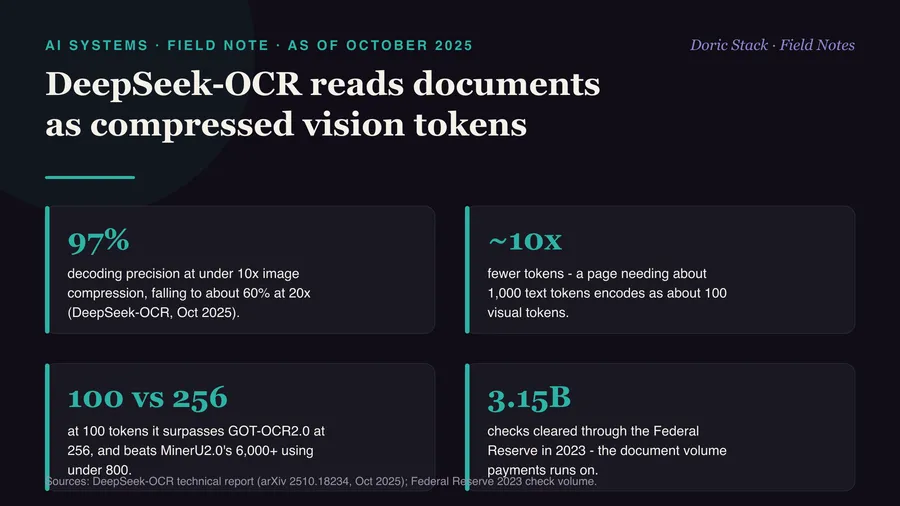
Payments runs on documents - checks, wires, invoices, KYC files - and the OCR that reads them chokes on handwriting and damage. DeepSeek-OCR processes a page as roughly 100 visual tokens instead of a thousand text tokens, and it is open source. The headline accuracy comes with a compression ceiling worth knowing.