Field note

Multi-model is the new multi-rail

Every payment system routes across multiple rails - ACH fails, traffic moves to wire, and wire is dear for small amounts so you route to RTP. Most AI systems still call one model and hope it stays up. The LLM gateway is the same routing engine payments has run for decades, and it needs the same three things to count.

Mar 23, 2026 · Navin Agrawal · AI systems · 3 min read

Multi-model is the new multi-rail

Visual brief

Visual brief

Multi-model is the new multi-rail

As of March 2026

Every payment system I have designed routes across multiple rails. ACH goes down, traffic moves to wire. Wire is expensive for small amounts, route to RTP. Monitor cost per transaction, fail over automatically, never depend on a single provider.

Most AI systems have not learned this yet. They pick one model per use case and hope it stays up - no fallback chain, no cost tracking, no circuit breaker. The AI world calls the fix an LLM gateway. Payments has called it a routing engine for decades.

Multi-provider

The norm

most enterprises now run several LLM providers, and 37% run five or more models at once (a16z, 2025).

The minimum

Three things

a fallback chain, a cost cap per request, and a circuit breaker. Have those and you have a gateway.

The risk

One provider

one provider with no fallback is a single point of failure dressed up as innovation.

The same four decisions

A routing engine and an LLM gateway answer the same questions. Which provider handles this request best. Which costs the least right now. Which responds fastest. And what happens when one disappears. Most enterprises already run several providers - one for reasoning, another for coding and nuanced writing, open source for cost-sensitive work - but most wire them up with no failover, which is the single-provider trap wearing a multi-model badge.

What transfers, and what does not

The cost structures differ - token pricing does not map cleanly to interchange. But the routing logic, the failover discipline, and the instinct to never trust a single provider transfer directly. When I built the BrainForge AI app, the first architecture decision felt familiar: dual providers with weighted routing, circuit breakers on errors, automatic failover, and cost monitoring per request, the same pattern I had used for payment rails at two banks.
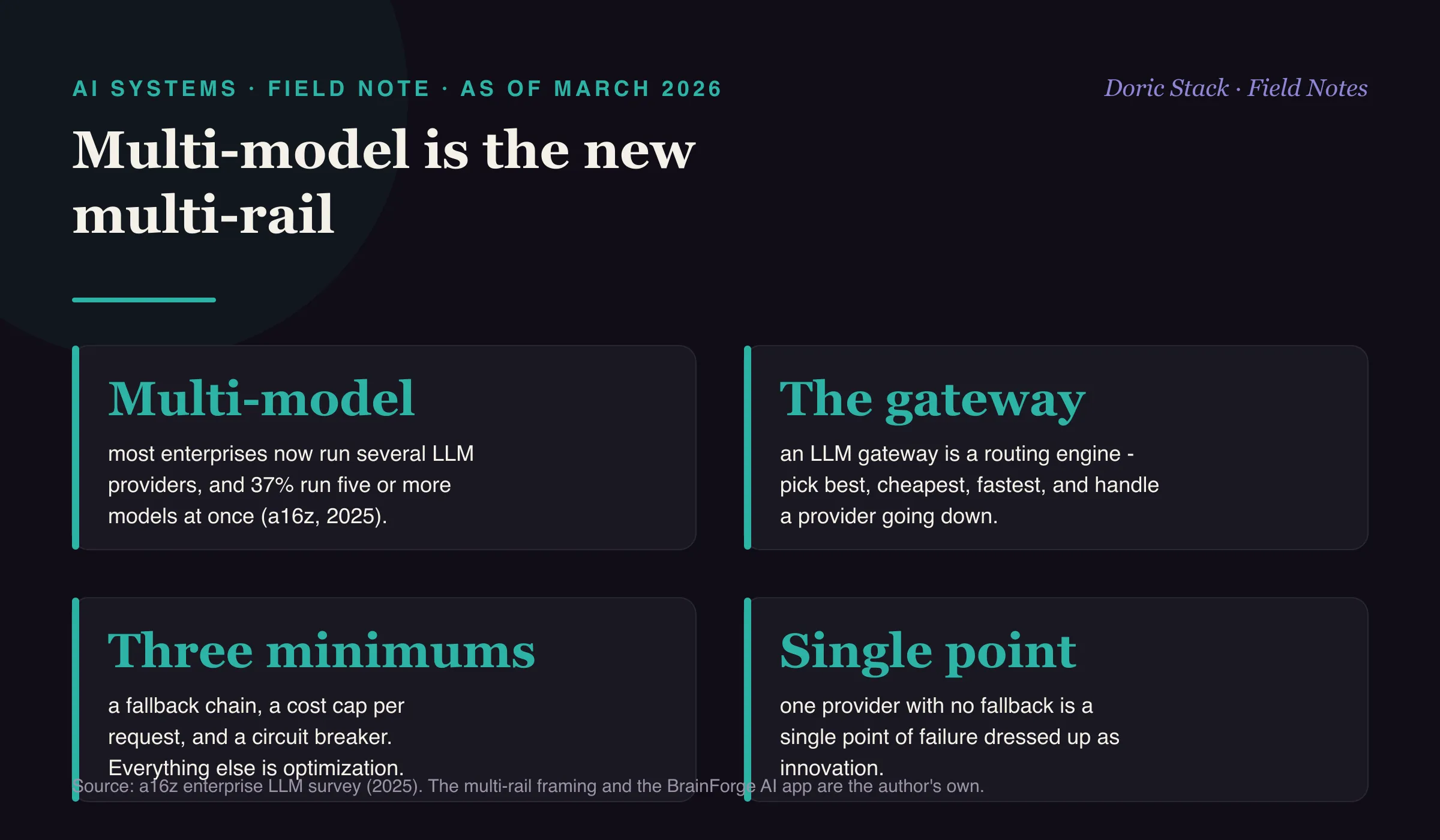
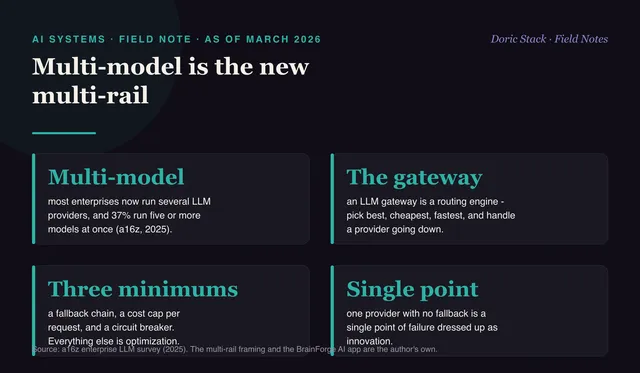
Multi-model is the new multi-rail (as of March 2026): most enterprises now run several LLM providers and about 37% run five or more models at once (a16z, 2025); an LLM gateway is a routing engine that picks the best, cheapest, and fastest provider and handles one going down; the minimum is a fallback chain, a cost cap per request, and a circuit breaker, and everything else is optimization; and one provider with no fallback is a single point of failure dressed up as innovation.
The same routing engine payments has run for decades, pointed at model providers instead of payment rails.
If your AI system calls one provider with no fallback, you have a single point of failure dressed up as innovation. Multi-model is the new multi-rail.
Was this useful?

Choose once.

Related Posts

View All Posts »
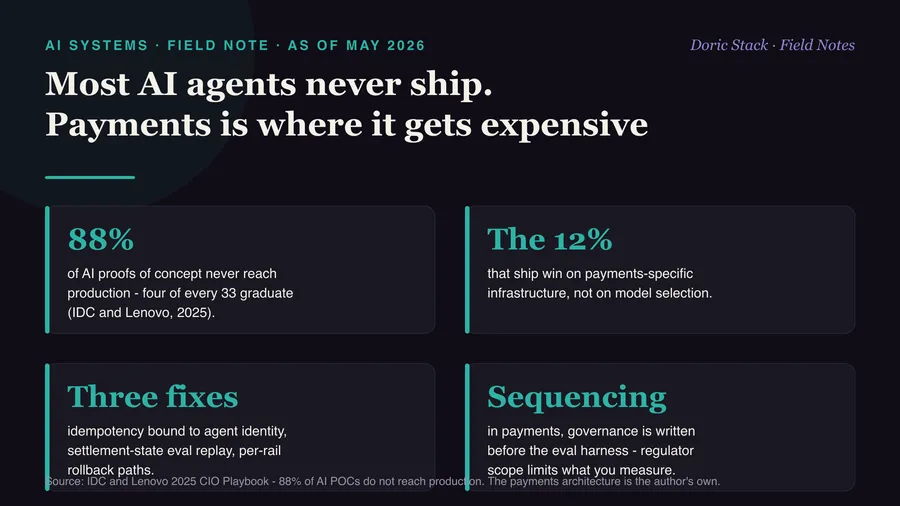
Most AI agents never reach production. Payments is where that gets expensive

Most AI agents never reach production. Payments is where that gets expensive

The widely cited figure is that 88 percent of AI proofs of concept never reach production. Agentic payments inherit that gap, and the teams that cross it are not winning on model selection. They are winning on payments-specific infrastructure that makes an agent idempotent, governable, and rollback-safe at the rail boundary.

Agents do the wiring, architects carry the tradeoffs

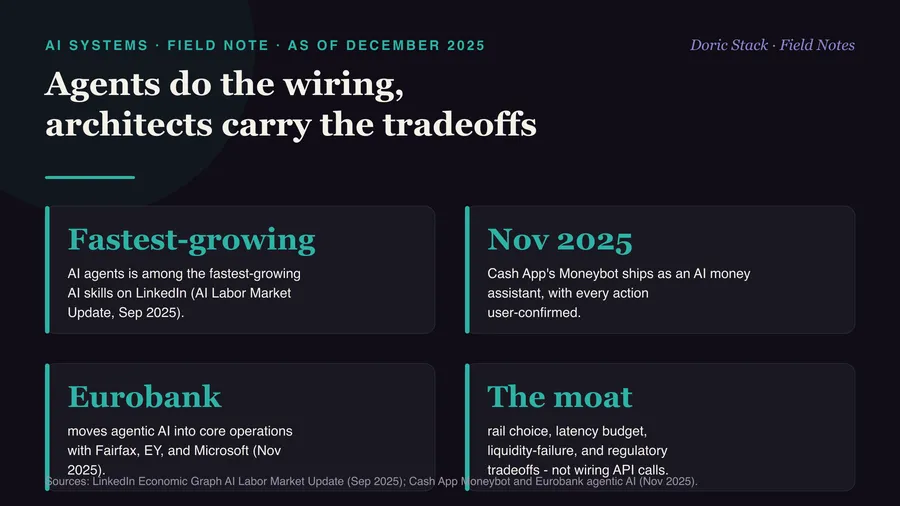
Agents do the wiring, architects carry the tradeoffs

AI agents are arriving faster than most banking career ladders can adapt, and the market is already rewarding people who work with them. The career moat was never wiring up another API call. It is the judgment calls agents cannot own - which rail to trust, how much latency to spend, who the regulator will be.

AI agents can buy now, and fraud systems were not built for it

AI agents can buy now, and fraud systems were not built for it

Stripe, OpenAI, and Google shipped protocols that let AI agents complete purchases inside a conversation. The rails are already fast enough. The problem is that fraud detection was architected around a human clicking buy on a trusted surface, and agents break that assumption.

DeepSeek-OCR reads documents as compressed vision tokens

DeepSeek-OCR reads documents as compressed vision tokens

Payments runs on documents - checks, wires, invoices, KYC files - and the OCR that reads them chokes on handwriting and damage. DeepSeek-OCR processes a page as roughly 100 visual tokens instead of a thousand text tokens, and it is open source. The headline accuracy comes with a compression ceiling worth knowing.