Field note

The leadership red flags nobody talks about

Talented technical leaders derail their teams without realizing it. The warning signs are quiet - the team stops bringing bad news, the best people stop pushing back, and the resumes get updated before anyone says a word.

Jun 27, 2025 · Navin Agrawal · Strategy · 2 min read

The leadership red flags nobody talks about

Visual brief

Visual brief

The leadership red flags nobody talks about

As of June 2025

The leadership failures that sink technical teams are quiet ones. By the time they are loud, your best people have already decided to leave.

I have watched talented technical leaders derail their teams without realizing it. The warning signs are subtle, and most of them are about what stops happening, not what happens.

The one that hits hardest: your best people are quietly updating their resumes. That open-door policy was apparently just decorative.

The quiet warning signs

The four categories of leadership red flag - silence, stalled growth, ownership gaps, and the exodus signal - drawn from technical-team experience.
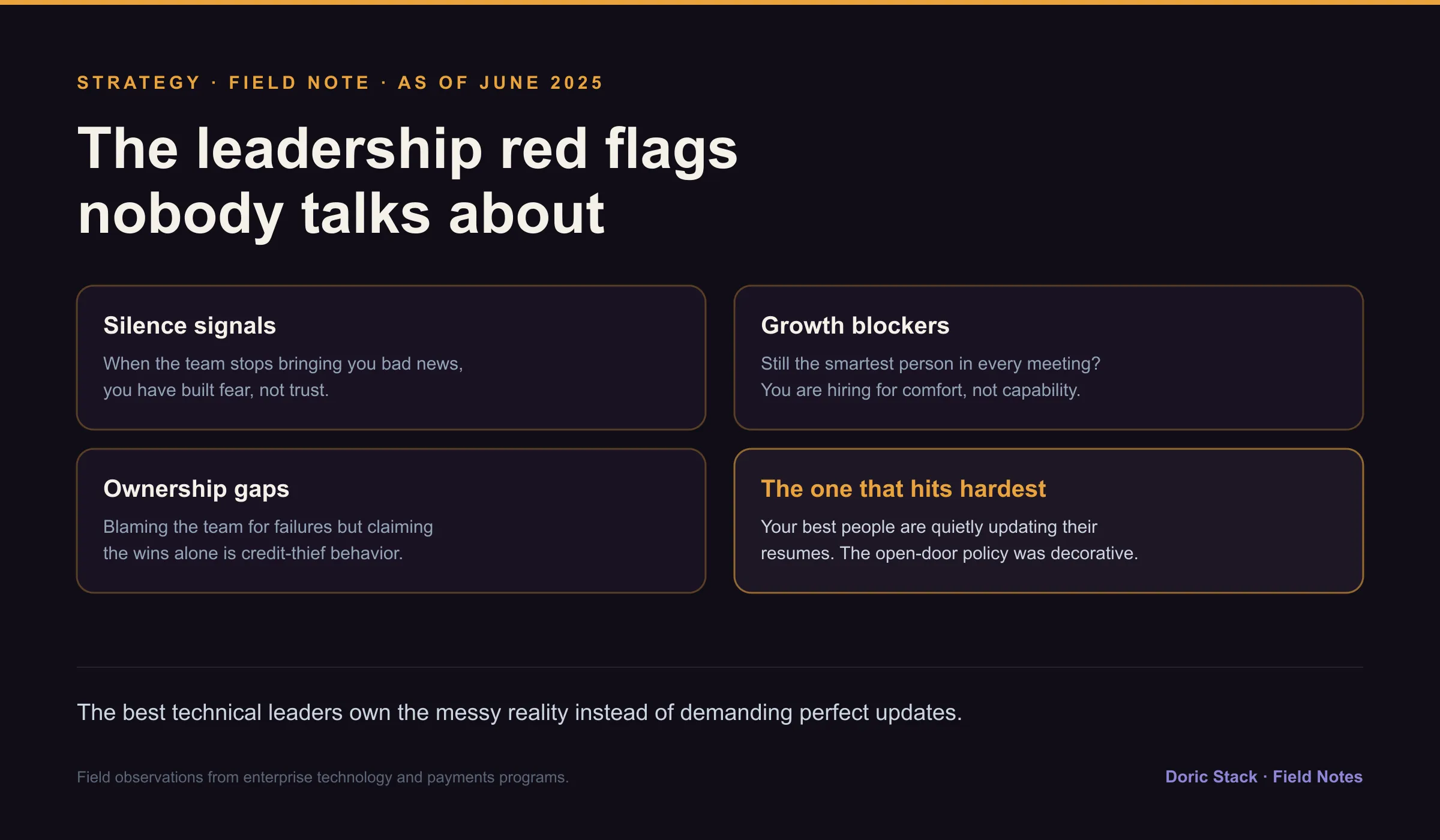
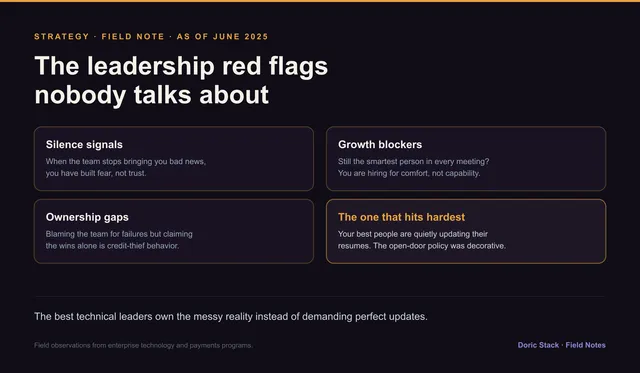
The leadership red flags nobody talks about: silence signals (the team stops bringing bad news - you built fear, not trust), growth blockers (you are still the smartest person in every meeting - hiring for comfort, not capability), ownership gaps (blaming the team for failures but claiming wins alone), and the hardest one (your best people are quietly updating their resumes).
Most of these are about what stops happening. That is what makes them easy to miss.

The quiet warning signs

The quiet warning signs

The leadership red flags nobody talks about: silence signals (the team stops bringing bad news - you built fear, not trust), growth blockers (you are still the smartest person in every meeting - hiring for comfort, not capability), ownership gaps (blaming the team for failures but claiming wins alone), and the hardest one (your best people are quietly updating their resumes).

The silence ones are the most dangerous because they look like calm. When the team stops bringing you bad news, you have trained them that bad news is unwelcome - so the real problems go underground. I have seen exactly this on enterprise technology programs: vendor delays, regulatory complexity, and scope creep get buried until they surface as a crisis, because somewhere along the way the team learned that leadership did not want to hear about problems. The growth blockers compound it. If you are still the smartest person in every meeting and nobody has outgrown their role in a year, you are not protecting quality - you are building a ceiling and calling it a standard.

What good looks like

The best technical leaders I have worked with did the opposite: they owned the messy reality instead of demanding perfect updates. Bad news traveled fast and safely. People outgrew their roles and left for bigger ones with the leader’s blessing. Credit flowed down, accountability flowed up.
Was this useful?

Choose once.

Related Posts

View All Posts »
BRICS payment rails are real, and they are at pilot scale

BRICS payment rails are real, and they are at pilot scale

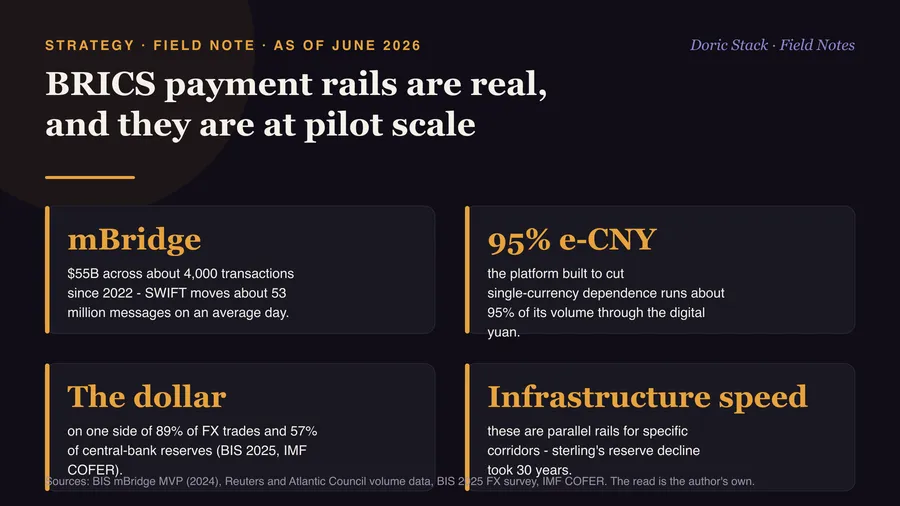
Five central banks are testing a settlement platform that does not touch SWIFT or the dollar. mBridge has been live since 2022, reached minimum viable product in mid-2024, and has moved about 55 billion dollars across roughly 4,000 transactions. SWIFT moves about 53 million messages on an average day. These are parallel rails for specific corridors, and infrastructure moves at infrastructure speed, not headline speed.

The core was never the bottleneck. The operating model was

The core was never the bottleneck. The operating model was

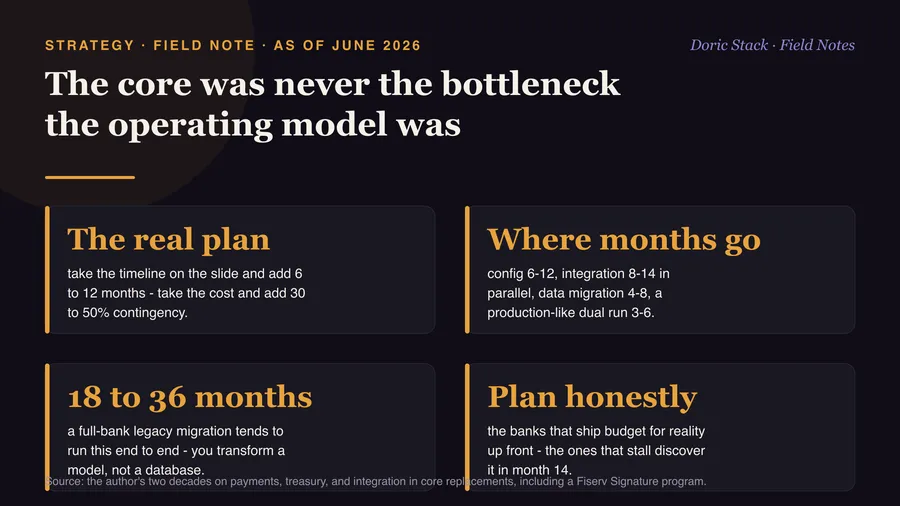
The plan said twelve months and the core replacement landed in year three. Nobody in that room was lying. They budgeted for a software install and got an operating-model change. After two decades on the payments, treasury, and integration side of these programs, here is the math I give clients before they sign a full legacy core replacement, and where the months actually go.

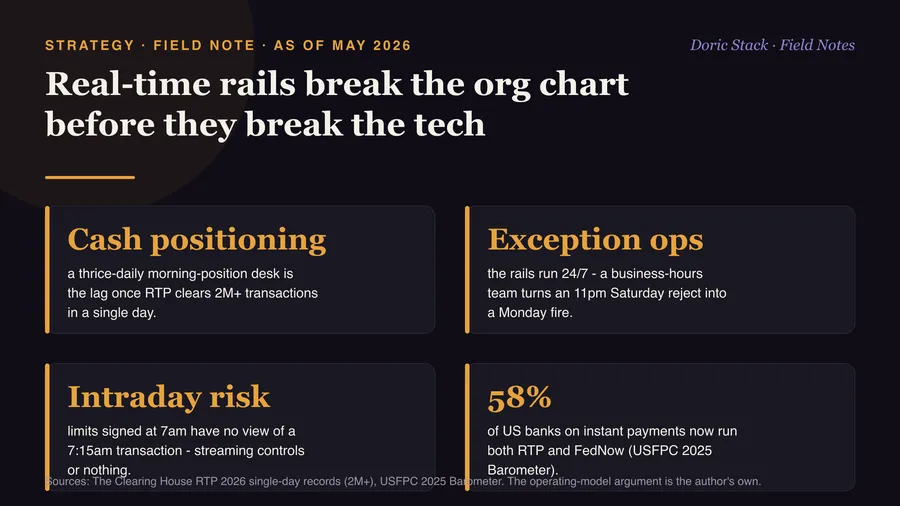
Real-time payments break your treasury org chart before they break your tech

Real-time payments break your treasury org chart before they break your tech

Your real-time rails settle in fifteen seconds. Your treasury org chart was built around an end-of-day cutoff. The gap between them is where the next reconciliation loss lives, and it shows up in three roles - cash positioning, exception ops, and intraday risk - long before it shows up in the tech stack.

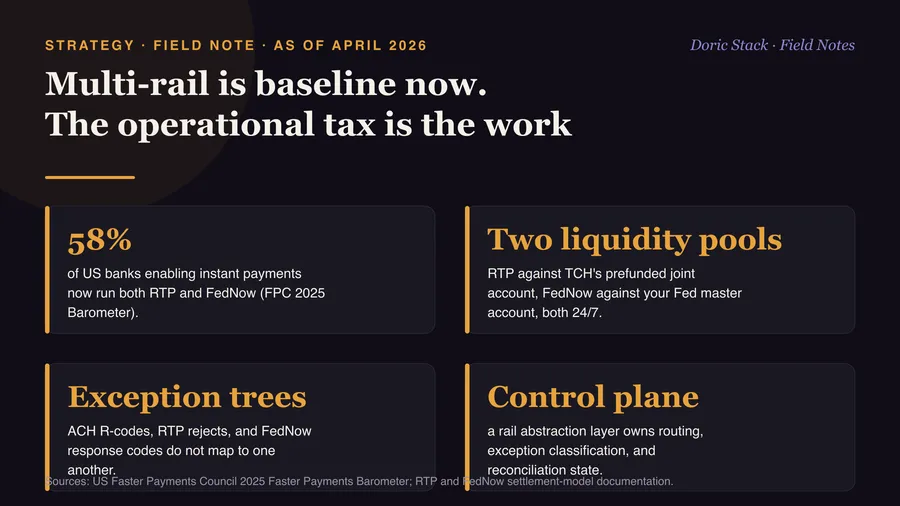
Multi-rail is baseline now. The operational tax is the work

Multi-rail is baseline now. The operational tax is the work

The multi-rail debate is over - most US banks enabling instant payments now run both RTP and FedNow. The cost moved from the strategy deck to the operations floor, where exception handling becomes a decision tree, reconciliation becomes real-time position-keeping across two liquidity models, and routing is a per-transaction decision in milliseconds.