Field note

BRICS payment rails are real, and they are at pilot scale

Five central banks are testing a settlement platform that does not touch SWIFT or the dollar. mBridge has been live since 2022, reached minimum viable product in mid-2024, and has moved about 55 billion dollars across roughly 4,000 transactions. SWIFT moves about 53 million messages on an average day. These are parallel rails for specific corridors, and infrastructure moves at infrastructure speed, not headline speed.

Jun 29, 2026 · Navin Agrawal · Strategy · 3 min read

BRICS payment rails are real, and they are at pilot scale

Visual brief

Visual brief

BRICS payment rails are real, and they are at pilot scale

As of June 2026

Five central banks are quietly testing a settlement platform that does not touch SWIFT or the dollar. The headlines treat that as the end of dollar dominance. The numbers treat it as a pilot. Both are looking at the same thing.

mBridge has been live since its 2022 pilot, with the People’s Bank of China, the Hong Kong Monetary Authority, the Bank of Thailand, and the Central Bank of the UAE, joined by Saudi Arabia at the minimum-viable-product stage in mid-2024. Total volume to date is around 55 billion dollars across roughly 4,000 transactions. For scale, SWIFT moved about 53 million messages on an average day in 2024.

What the platform actually is

mBridge is a multi-central-bank digital currency settlement platform, real and running, not vaporware. It reached minimum viable product in mid-2024. The Bank for International Settlements helped build it for about four years and then exited in October 2024. Its general manager, Agustin Carstens, said the reason was project maturity, that the partners could carry it forward on their own, and he publicly rejected the idea that mBridge was a BRICS or sanctions-evasion vehicle, noting only that the BIS does not operate with sanctioned jurisdictions. Read against the timing, the exit still tells you the project sits on politically sensitive ground, which is my own read rather than the BIS position.

The irony is in the composition. The platform built to reduce dependence on a single dominant currency runs about 95 percent of its volume through China’s digital yuan, per Atlantic Council analysis. One concentration risk has been swapped for another.

The roadmap is long

India holds the 2026 BRICS chairmanship and has put cross-border CBDC linkage on the summit agenda. A research institute, not a central bank, launched a gold-backed pilot settlement unit, roughly 40 percent gold, in October 2025. Russian officials keep pushing for a working system, and the timelines analysts attach to it run toward 2030. In government infrastructure years, that probably means later still.

mBridge to date

$55B

about 55 billion dollars across roughly 4,000 transactions since 2022, per Reuters and Atlantic Council data.

SWIFT, an average day

53M msgs

SWIFT moved about 53 million messages a day in 2024 - mBridge is a rounding error against that baseline.

The dollar

89% / 57%

on one side of 89 percent of FX trades (BIS 2025) and 57 percent of allocated reserves (IMF COFER).
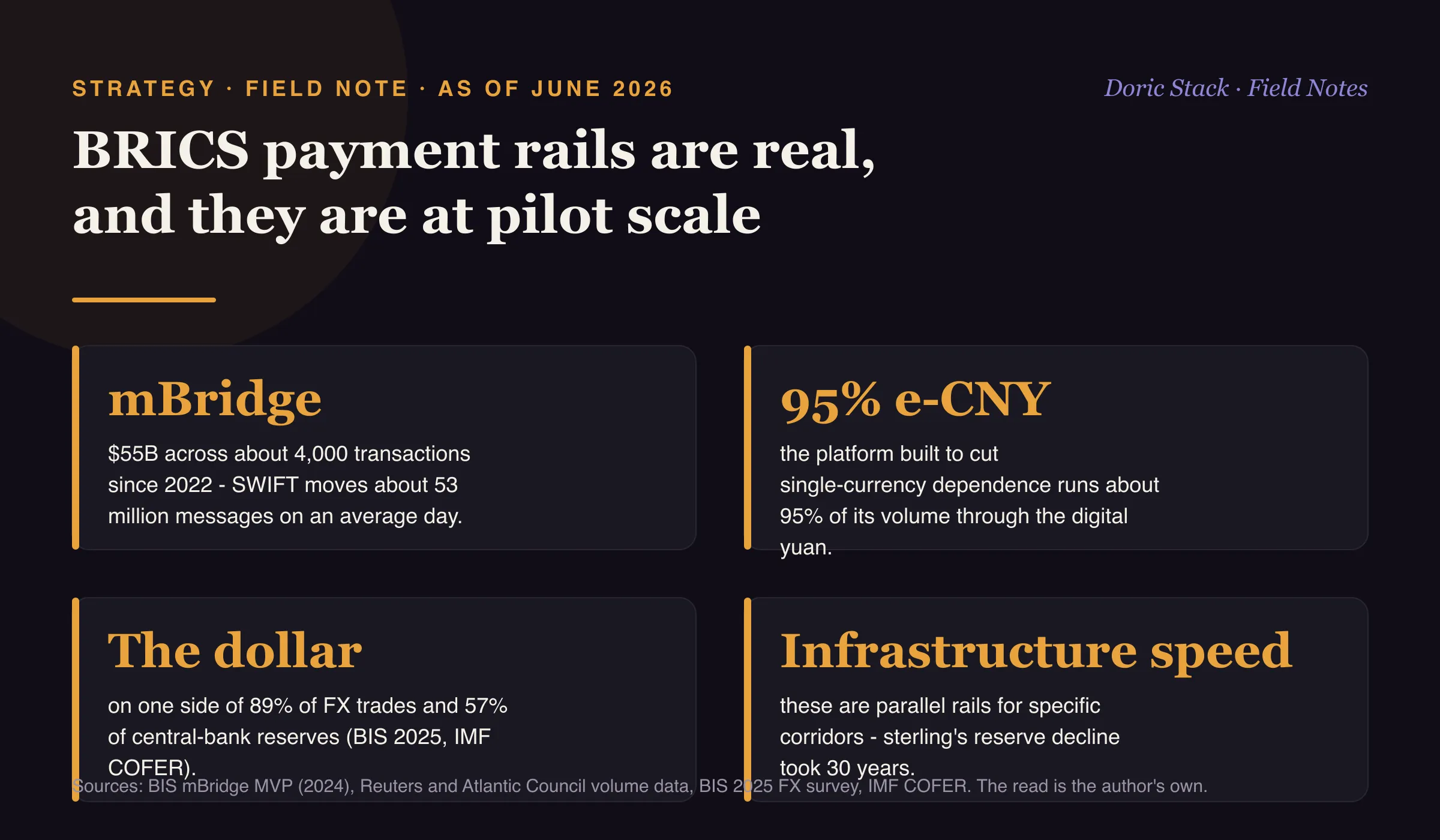
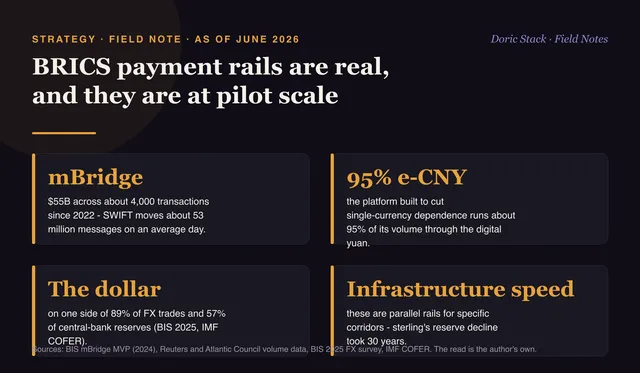
BRICS payment rails are real and they are at pilot scale (as of June 2026): mBridge has moved about 55 billion dollars across roughly 4,000 transactions since 2022 while SWIFT moves about 53 million messages on an average day; the platform built to cut single-currency dependence runs about 95 percent of its volume through China's digital yuan; the dollar sits on one side of 89 percent of FX trades per the BIS 2025 survey and 57 percent of allocated central-bank reserves per IMF COFER; and these are parallel rails for specific corridors, with sterling's reserve-currency decline having taken about 30 years.
Real rails, pilot scale, one currency doing 95 percent of the work. The headline and the data are describing the same platform.
These are parallel rails at pilot scale. They matter for specific corridors and route around the existing system in targeted spots. They do not replace it. Infrastructure moves at infrastructure speed, not headline speed.
Was this useful?

Choose once.

Related Posts

View All Posts »
The core was never the bottleneck. The operating model was

The core was never the bottleneck. The operating model was

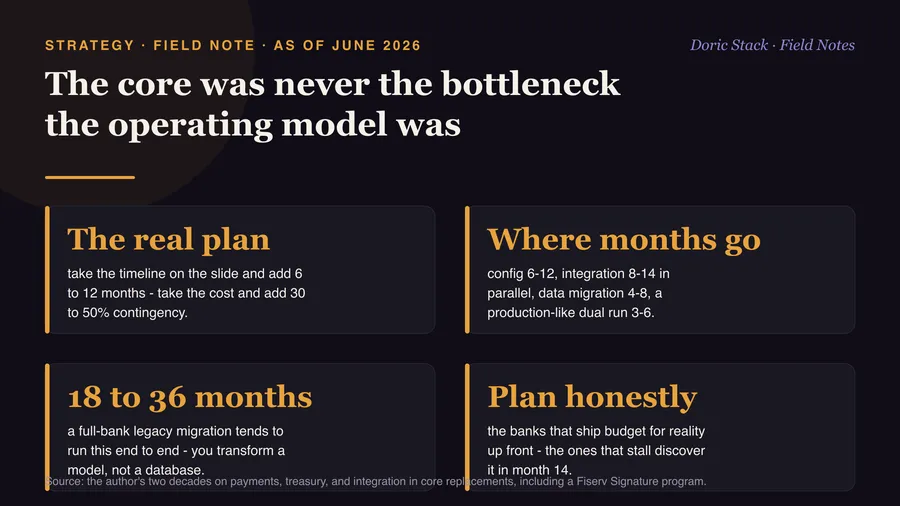
The plan said twelve months and the core replacement landed in year three. Nobody in that room was lying. They budgeted for a software install and got an operating-model change. After two decades on the payments, treasury, and integration side of these programs, here is the math I give clients before they sign a full legacy core replacement, and where the months actually go.

Real-time payments break your treasury org chart before they break your tech

Real-time payments break your treasury org chart before they break your tech

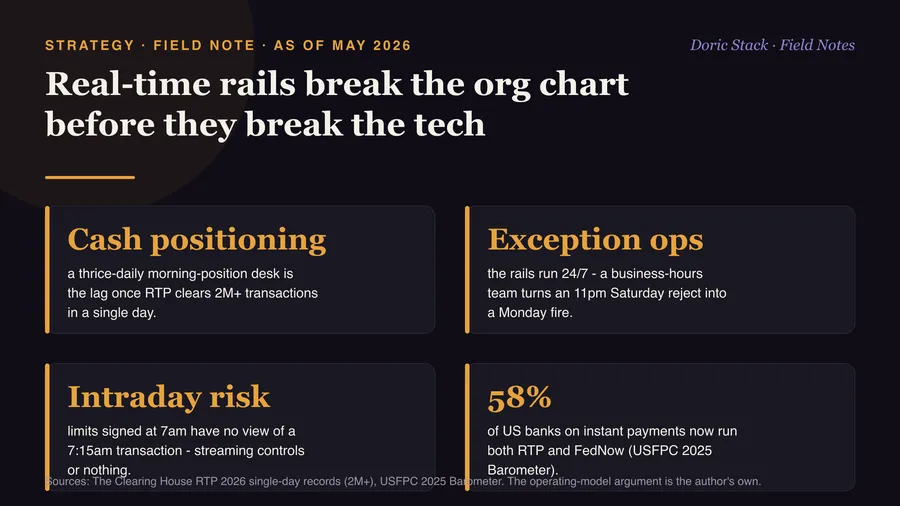
Your real-time rails settle in fifteen seconds. Your treasury org chart was built around an end-of-day cutoff. The gap between them is where the next reconciliation loss lives, and it shows up in three roles - cash positioning, exception ops, and intraday risk - long before it shows up in the tech stack.

Multi-rail is baseline now. The operational tax is the work

Multi-rail is baseline now. The operational tax is the work

The multi-rail debate is over - most US banks enabling instant payments now run both RTP and FedNow. The cost moved from the strategy deck to the operations floor, where exception handling becomes a decision tree, reconciliation becomes real-time position-keeping across two liquidity models, and routing is a per-transaction decision in milliseconds.

The operating model kills payment modernization, not the tech

The operating model kills payment modernization, not the tech

A bank buys a modern payment platform and keeps the 2019 team structure, the same escalation matrix, the same three-person on-call rotation. The platform ships daily. The governance model says 90 days. Most modernization failures are operating-model failures, and the org chart defeats the architecture every time.