
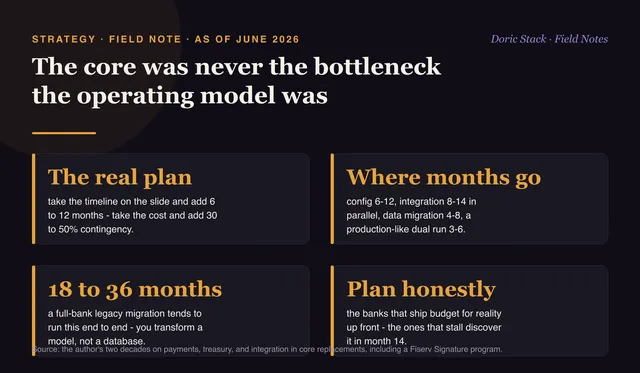
As of June 2026
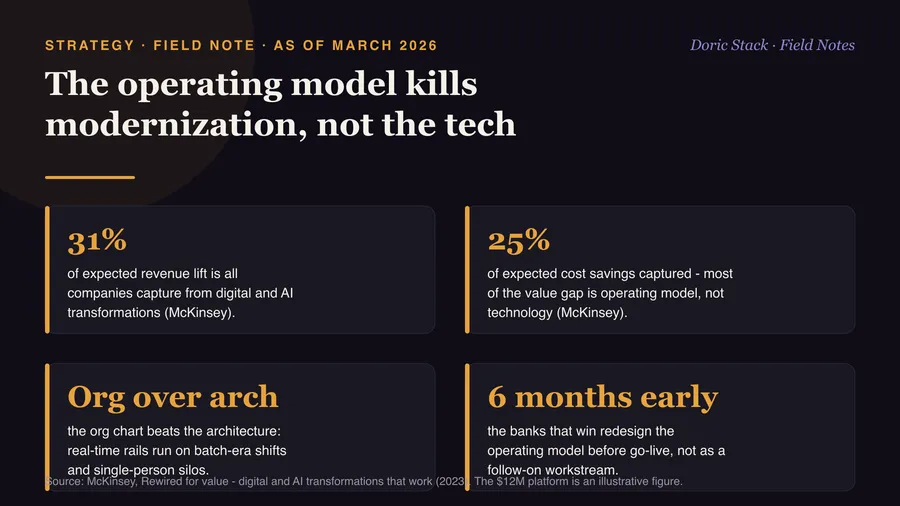
The plan said twelve months. The core replacement landed in year three. Nobody in that room was lying. They budgeted for a software install and got an operating-model change, and that is the gap nobody prices at kickoff.
I have spent two decades on the payments, treasury, and integration side of these programs. It is the seat where you watch the core get blamed while the real delays pile up everywhere else. None of this argues against modernizing. It argues for planning honestly, before the kickoff deck.
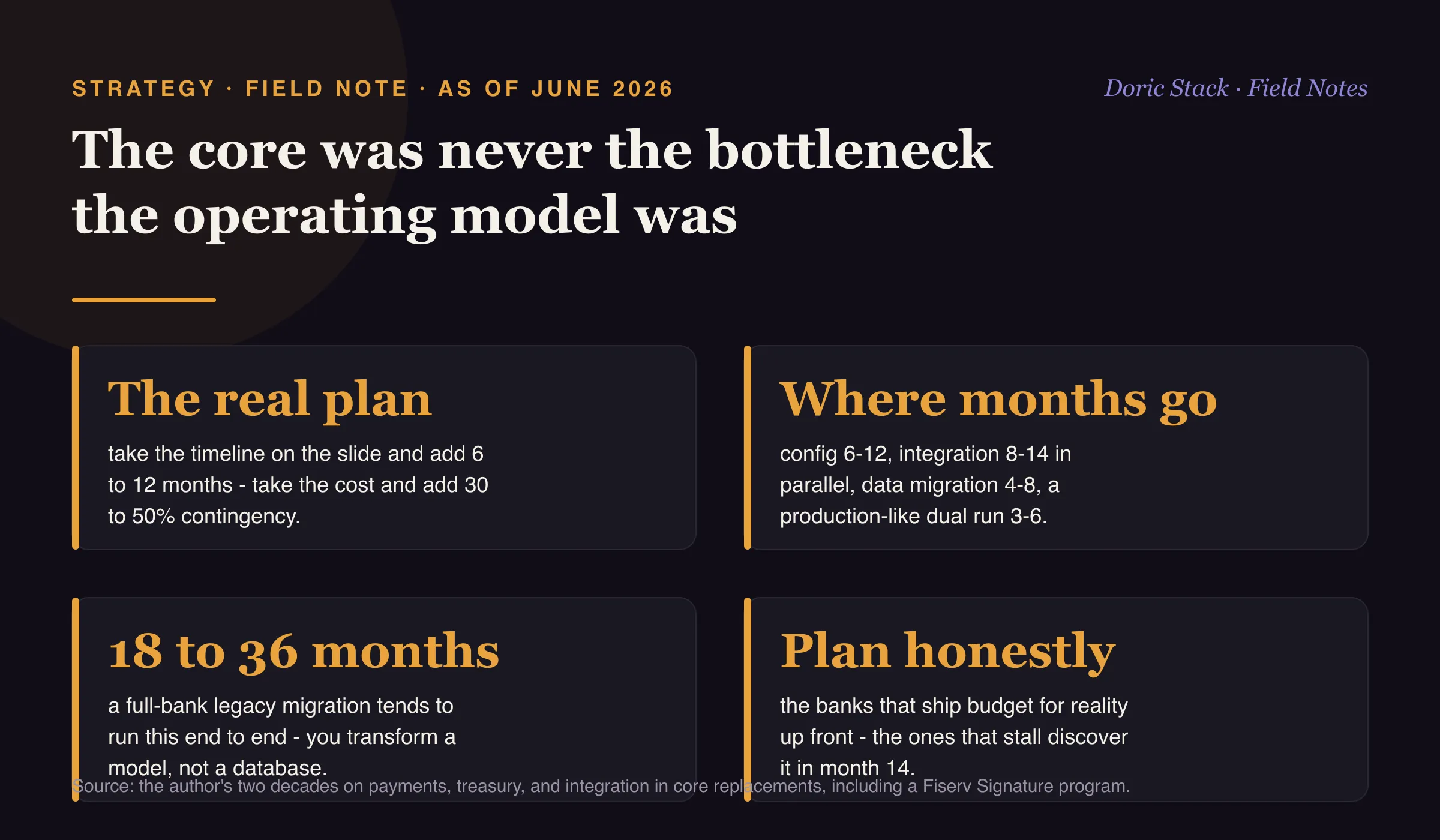
The math I give clients before they sign a full legacy deposit-core replacement is blunt. Take the timeline on the slide and add six to twelve months. Take the cost and add thirty to fifty percent contingency. That is the real plan, and anything better than it is upside rather than the baseline.
Where the months actually go
From what I have seen up close, the time lands in four places. Configuration runs six to twelve months. Integration to the existing rails and the treasury stack runs eight to fourteen, in parallel rather than after. Data migration and validation take four to eight. A production-like dual run before cutover takes another three to six. On a Fiserv Signature integration I worked, the core itself was never the bottleneck. The end-of-day batch windows were, and so was every downstream system that assumed the old behavior, each one needing a re-test before cutover.
Cloud-native does not make it free
Greenfield on a modern, cloud-native core like Thought Machine’s Vault can move fast. A full-bank legacy migration still tends to run eighteen to thirty-six months end to end, and a complete multi-product decommission can run longer, because you are transforming an operating model, not swapping a database.
The real plan
+6-12 mo
take the timeline on the slide and add 6 to 12 months, take the cost and add 30 to 50 percent contingency.
End to end
18-36 mo
a full-bank legacy migration tends to run this long, because you transform an operating model, not a database.
The tell
Month 14
the banks that ship budgeted for reality up front - the ones that stall discovered it in month 14.
Plenty of banks still run cores that cannot do real-time natively. The work is necessary. The failure is planning for the migration on the slide instead of the one you will actually have.