Field note

Real-time payments break your treasury org chart before they break your tech

Your real-time rails settle in fifteen seconds. Your treasury org chart was built around an end-of-day cutoff. The gap between them is where the next reconciliation loss lives, and it shows up in three roles - cash positioning, exception ops, and intraday risk - long before it shows up in the tech stack.

May 11, 2026 · Navin Agrawal · Strategy · 3 min read

Real-time payments break your treasury org chart before they break your tech

Visual brief

Visual brief

Real-time payments break your treasury org chart before they break your tech

As of May 2026

Your real-time rails settle in fifteen seconds. Your treasury org chart was built around an end-of-day cutoff. The gap between those two facts is where your next reconciliation loss lives.

When I sat in the treasury and payments architecture seat at BankUnited, the lesson nobody warned us about was that the technology stack was the easy part. The org chart was the hard part. Three roles break first when real-time rails reach production volume, and none of them are engineering roles.

Cash positioning

Moving number

a thrice-daily morning-position desk publishes history once RTP clears 2M+ transactions in a single day.

Exception ops

24/7

a business-hours team turns an 11pm Saturday FedNow reject into a Monday morning fire.

Adoption

58%

of US banks on instant payments now run both RTP and FedNow (USFPC 2025 Barometer).

Cash positioning becomes a moving target

The morning-position desk worked when ACH cleared at fixed windows, because the number it published at 8am was still true at noon. That is no longer the case. RTP single-day volume crossed two million transactions in early 2026, with a record above 2.2 million set at the start of May, per The Clearing House. When the rail moves that fast, position is a moving number, and a desk that refreshes it three times a day is publishing history. The desk is not wrong. The cadence is.

Exception ops keeps business hours the rails do not

Your exceptions team works business hours. The rails do not. A FedNow reject at 11pm on a Saturday becomes a Monday morning fire that should have been resolved Saturday night, and every hour it sits unworked is an hour the counterparty is also reasoning about it. The mismatch is not a staffing gap you can close with overtime. It is a coverage model that has to match the rail.

The industry treats running both rails as a tech-adoption milestone. It is actually an operating-model load, and the org chart absorbs it first.
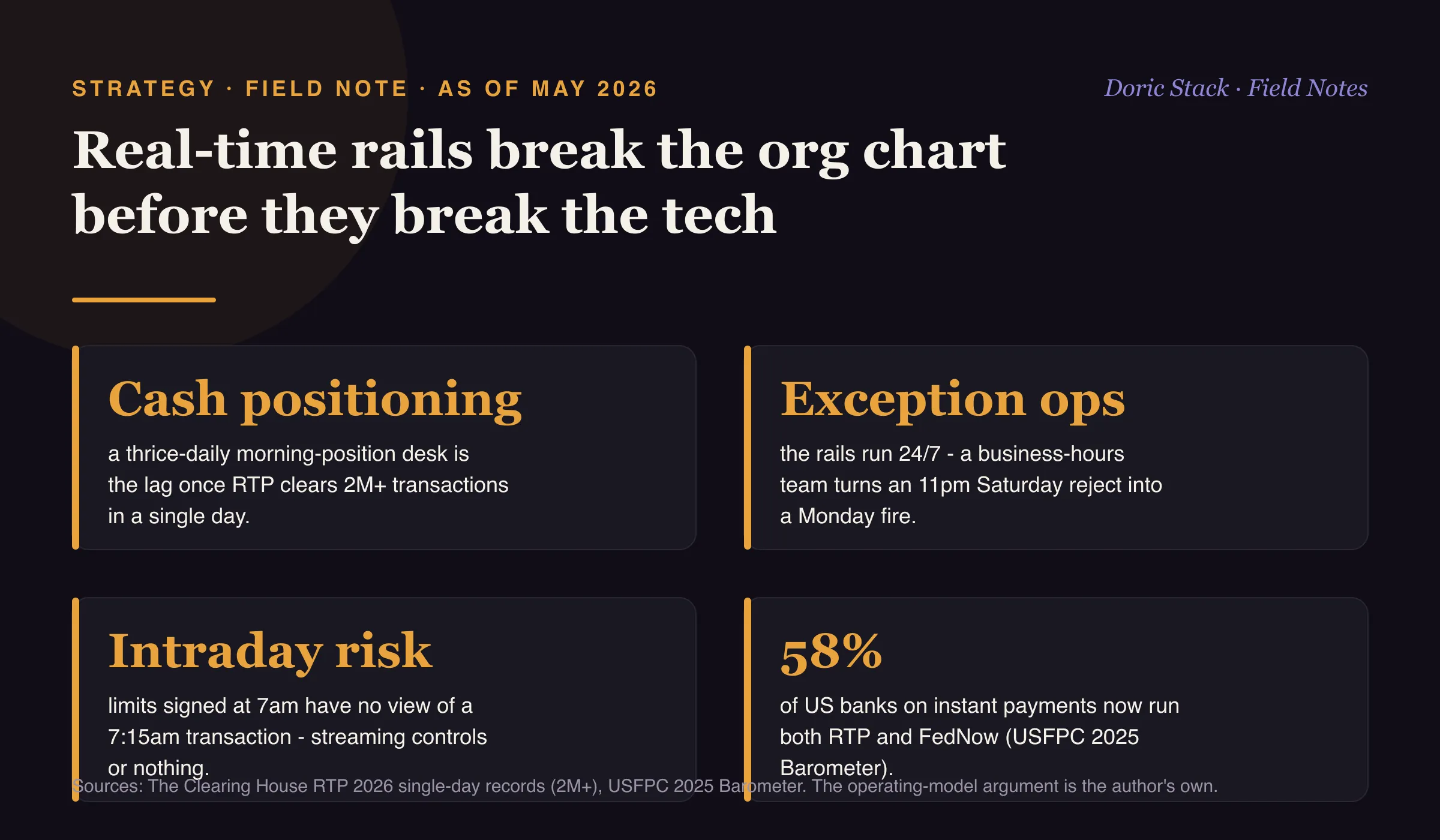
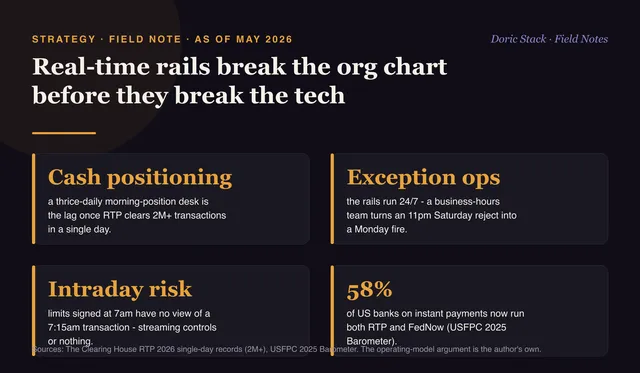
Real-time payments break your treasury org chart before they break your tech (as of May 2026): cash positioning becomes a moving number when a thrice-daily morning-position desk lags RTP clearing more than two million transactions in a single day; exception operations on business hours turn an 11pm Saturday FedNow reject into a Monday fire because the rails run 24/7; intraday risk limits signed at 7am have no view of a 7:15am transaction so streaming controls are the only way to keep up; and 58 percent of US banks on instant payments now run both RTP and FedNow per the US Faster Payments Council 2025 Barometer, which is an operating-model load and not just a technology milestone.
The tech stack is probably ready. The org chart, built around a cutoff that no longer exists, is not.

Intraday risk has no view of the transaction that already fired

The risk officer who signs daily limits at 7am has no live view of a transaction that fired at 7:15am. On a real-time rail that is not a reporting lag, it is an exposure the bank is carrying blind. Streaming controls are the only way to keep up, and the headcount math behind that has not caught up to the rails. Set against this, the adoption statistic reads differently. The US Faster Payments Council’s 2025 Faster Payments Barometer found that 58 percent of US institutions running instant payments now run both RTP and FedNow. The industry frames that as a technology-adoption milestone. It is an operating-model load, and the load lands on three desks before it lands on the stack.
Was this useful?

Choose once.

Related Posts

View All Posts »
Multi-rail is baseline now. The operational tax is the work

Multi-rail is baseline now. The operational tax is the work

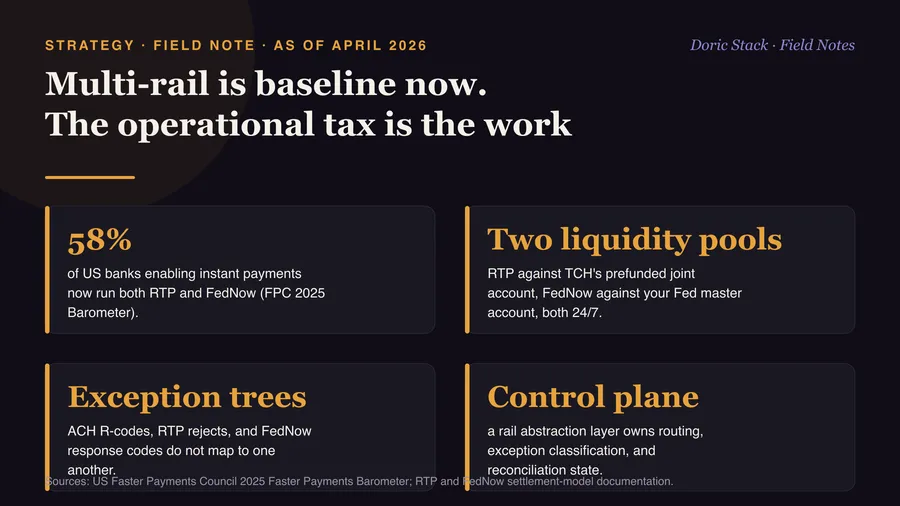
The multi-rail debate is over - most US banks enabling instant payments now run both RTP and FedNow. The cost moved from the strategy deck to the operations floor, where exception handling becomes a decision tree, reconciliation becomes real-time position-keeping across two liquidity models, and routing is a per-transaction decision in milliseconds.

The operating model kills payment modernization, not the tech

The operating model kills payment modernization, not the tech

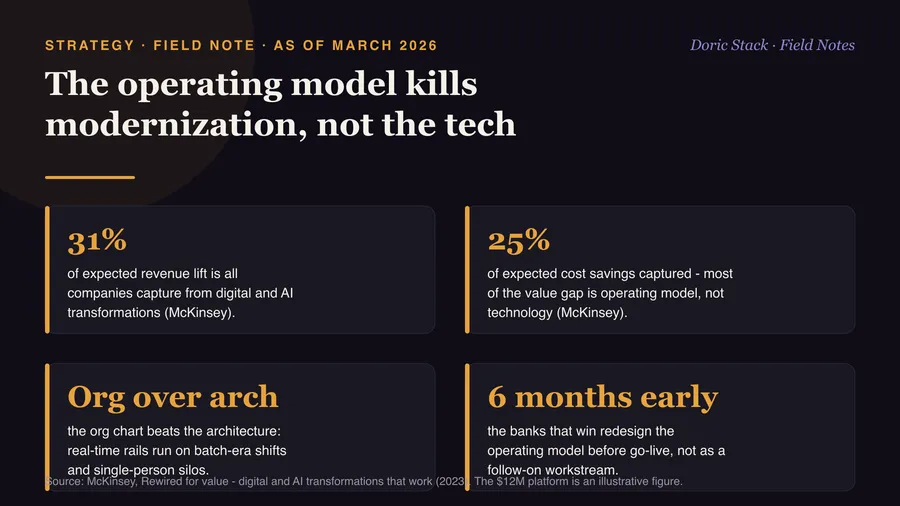
A bank buys a modern payment platform and keeps the 2019 team structure, the same escalation matrix, the same three-person on-call rotation. The platform ships daily. The governance model says 90 days. Most modernization failures are operating-model failures, and the org chart defeats the architecture every time.

Wire investigations become structured workflows

Wire investigations become structured workflows

A wire investigation is the moment confidence breaks - the payment has moved and the clock is running. The Fedwire Funds Service changes planned for November 2026 turn investigation messages into structured workflows and add a Create Payment Return feature. Treat it as a rail feature, not a back-office patch.

Design open banking for the rule that keeps moving

Design open banking for the rule that keeps moving

The CFPB finalized US open banking under Section 1033 in October 2024, a federal court enjoined enforcement a year later, and the rule is now back in reconsideration. The data layer that survives that whiplash is the deliverable, not the API. Build for reversals, not launch day.