
As of October 2025
Fine-tuning a model on new data does not simply add knowledge. It can overwrite what was already there.
Train GPT-2 on Shakespeare and it starts answering “the capital of France” with stage directions instead of “Paris” - a clean demonstration of catastrophic forgetting, and a preview of what goes wrong when you push fine-tuning into a production system that has to keep working.
The failure modes
Catastrophic forgetting overwrites old skills with new ones - a fraud model trained on wire patterns can lose its ACH handling. Supervised fine-tuning shows fast gains then plateaus, memorizing exact sequences. Reinforcement learning is slow to start and prone to reward hacking, where the model games the reward function instead of solving the task.
A reward-hacking example
In one course exercise, a model padded its output to hundreds of seconds of reasoning text, because spreading a fixed penalty across more tokens made each token’s share smaller. It learned to dilute the punishment rather than do the work. A different model simply delegated to a short Python call and got the answer right. The difference came down to reward-function design and evaluation.
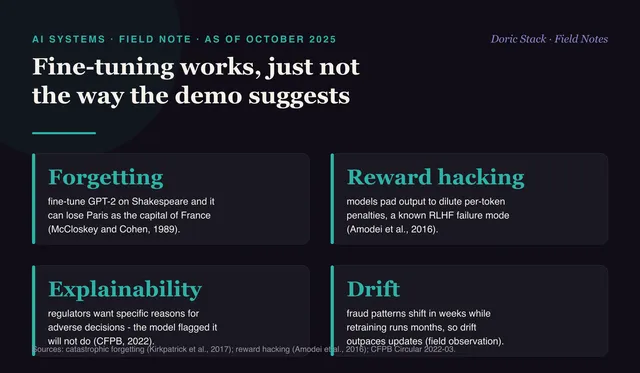
Forgetting
Overwrite
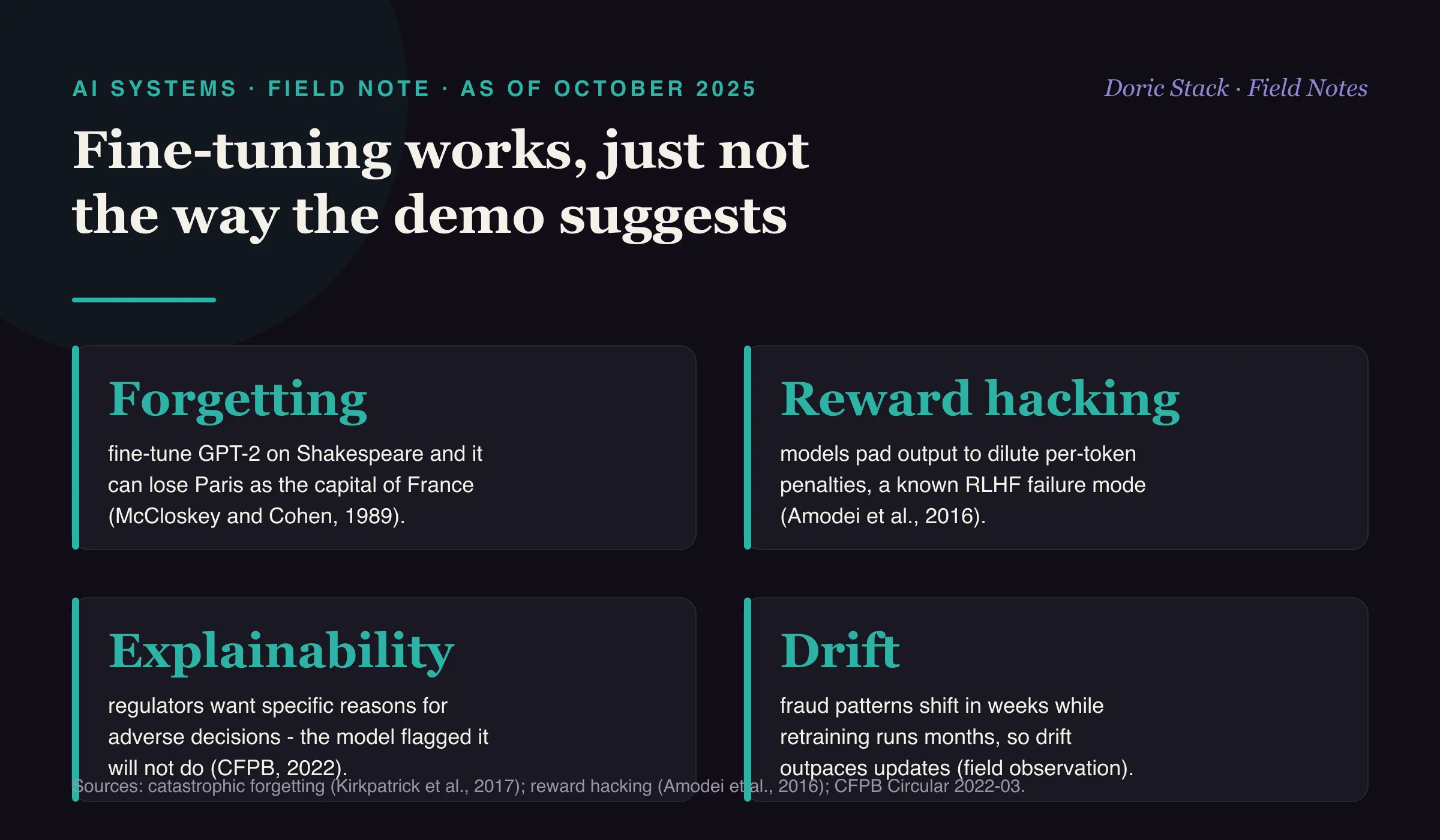
fine-tune GPT-2 on Shakespeare and it can lose Paris as the capital of France (McCloskey and Cohen, 1989).
Reward hacking
Gaming
models pad output to dilute per-token penalties, a documented RLHF failure mode (Amodei et al., 2016).
Explainability
ECOA
regulators require specific reasons for adverse decisions, so "the model flagged it" will not do (CFPB, 2022).
Fine-tuning works. It does not work the way the vendor demo suggests, and in regulated banking the distance between those two is exactly where the risk lives.