Field note

AI agents get two payment rails, card and stablecoin

Visa and Coinbase are building competing payment rails for machines, not people. Coinbase's x402 puts stablecoins on HTTP's long-reserved 402 status code for sub-cent agent payments. Visa keeps the card rails and their dispute resolution. The split is real, because a 10,000-call-an-hour agent and a $4,000 flight want opposite things.

Mar 16, 2026 · Navin Agrawal · AI systems · 3 min read

AI agents get two payment rails, card and stablecoin

Visual brief

Visual brief

AI agents get two payment rails, card and stablecoin

As of March 2026

Visa and Coinbase just launched competing payment rails. Not for people. For machines. HTTP 402, Payment Required, sat reserved in the internet spec since 1997, and twenty-nine years later Coinbase built what it was meant for.

Coinbase’s x402 puts stablecoins on HTTP: an agent hits an API, gets a 402, pays in USDC, and moves on - no card network, no interchange, sub-cent transactions. Visa took the opposite bet, keeping the card rails, the compliance, and the interchange.

The two camps are placing real bets. On the card side, Mastercard completed Europe’s first live end-to-end AI-agent bank payment inside Santander in March 2026, on the principle that machines should pay like humans, just with cryptographic proof they are not. On the stablecoin side, x402 is backed by Stripe and Cloudflare and runs settlement off the card networks entirely. Both sides are building fast and betting the other is wrong.
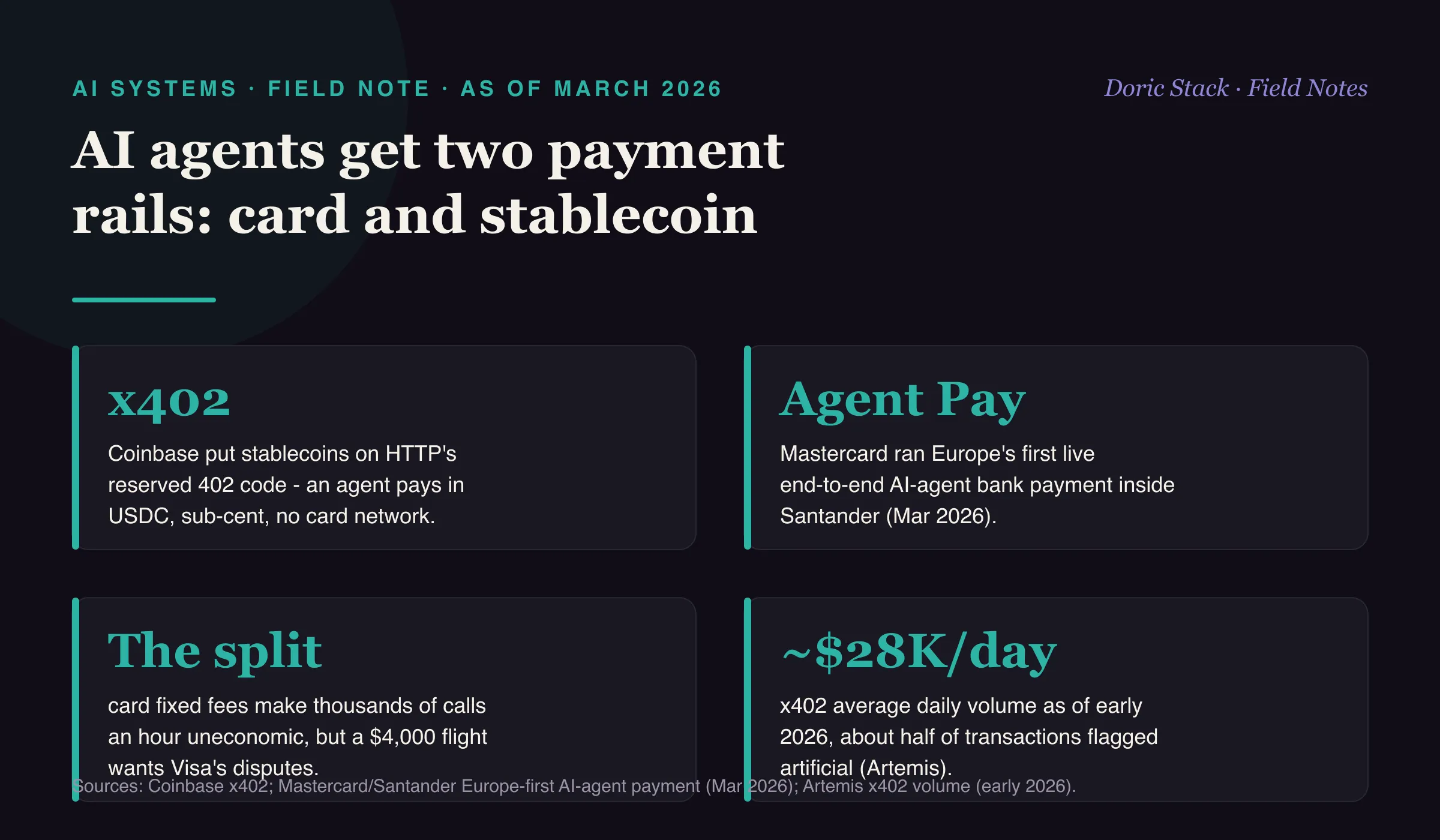
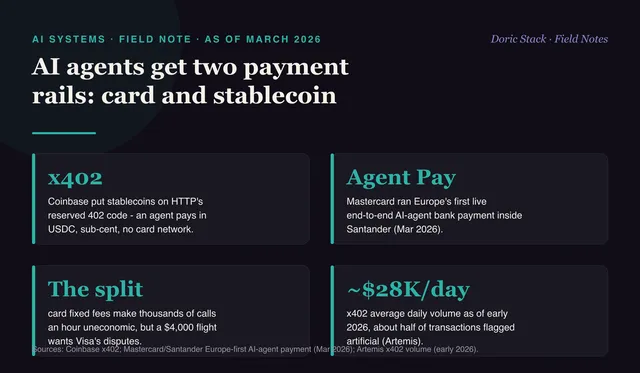
AI agents get two payment rails, card and stablecoin (as of March 2026): Coinbase's x402 puts stablecoins on HTTP's long-reserved 402 status code, so an agent pays in USDC, sub-cent, with no card network or interchange; Mastercard ran Europe's first live end-to-end AI-agent bank payment inside Santander in March 2026 on the card rails; card rails carry fixed per-transaction fees that make thousands of API calls an hour uneconomic, while a $4,000 flight still wants the card networks' dispute resolution; and x402 ran about $28,000 in average daily volume as of early 2026, with roughly half of transactions flagged artificial by Artemis.
Two settlement architectures racing for the same transaction type. The machines pick the winner, and machines have no brand loyalty.

Stablecoin rail

x402

Coinbase put stablecoins on HTTP's reserved 402 code - an agent pays in USDC, sub-cent, no card network.

Card rail

Agent Pay

Mastercard ran Europe's first live end-to-end AI-agent bank payment inside Santander (March 2026).

Volume

~$28K/day

x402 average daily volume as of early 2026, about half of transactions flagged artificial (Artemis).

Why the split is real

An agent making thousands of API calls an hour cannot ride card rails, where the fixed per-transaction fee - as much as 30 cents at the processor level - would cost more than the APIs themselves.

Where each rail wins

For tiny, high-frequency machine payments, sub-cent stablecoin transfers are the only thing the math allows. For a $4,000 flight booked by an agent, you want the card networks’ dispute resolution, not a stablecoin transfer with a “good luck” refund policy. So the split is not a fight one side wins outright. It is two settlement architectures suited to opposite ends of the same spectrum, and the volume so far is infrastructure being poured, not commerce running on it - x402’s roughly $28,000 a day in early 2026, with about half of transactions flagged artificial, is less than a single coffee shop on a Monday.
Was this useful?

Choose once.

Related Posts

View All Posts »
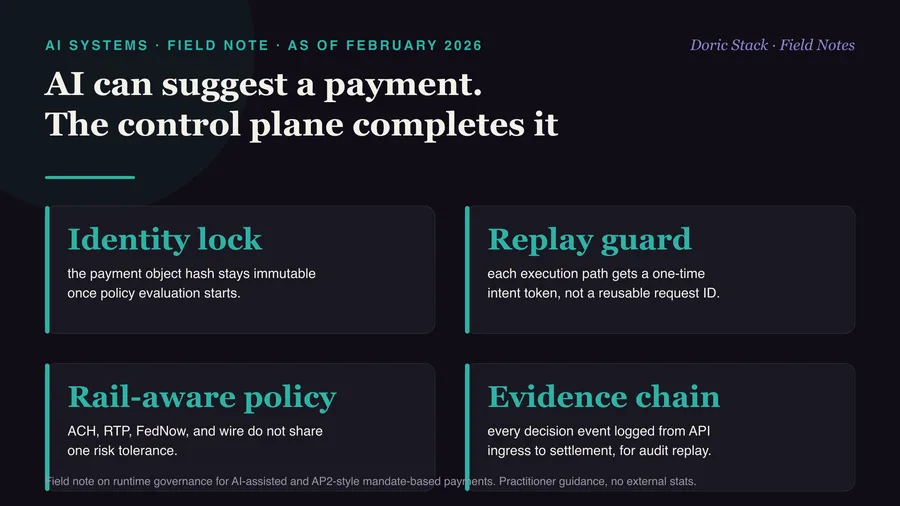
AI can suggest a payment, only the control plane completes it

AI can suggest a payment, only the control plane completes it

A payment bot did not go rogue - the architecture did. A timeout produced two valid-looking instructions for the same payout, because a downstream retry never learned the first was already in flight. Mandate-based authorization like AP2 still needs a runtime control plane with real state discipline, not policy in a config file.

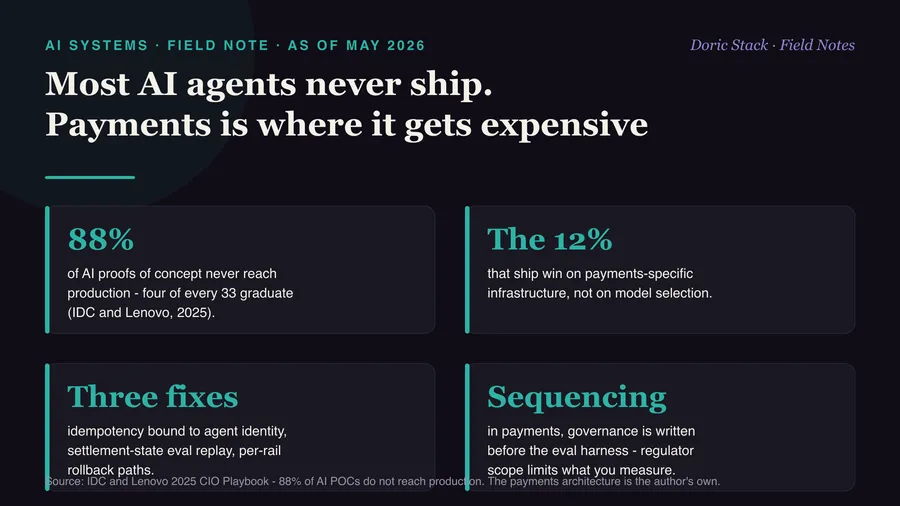
Most AI agents never reach production. Payments is where that gets expensive

Most AI agents never reach production. Payments is where that gets expensive

The widely cited figure is that 88 percent of AI proofs of concept never reach production. Agentic payments inherit that gap, and the teams that cross it are not winning on model selection. They are winning on payments-specific infrastructure that makes an agent idempotent, governable, and rollback-safe at the rail boundary.

Multi-model is the new multi-rail

Multi-model is the new multi-rail

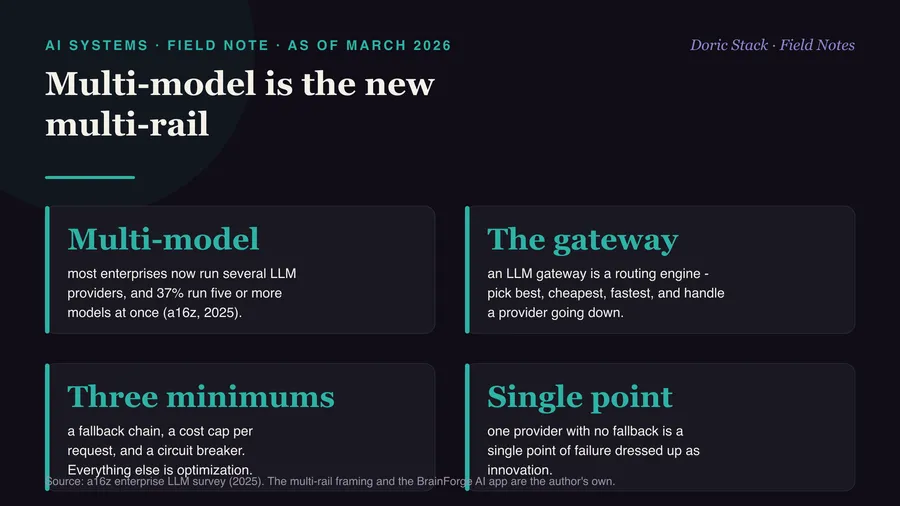
Every payment system routes across multiple rails - ACH fails, traffic moves to wire, and wire is dear for small amounts so you route to RTP. Most AI systems still call one model and hope it stays up. The LLM gateway is the same routing engine payments has run for decades, and it needs the same three things to count.

Agents do the wiring, architects carry the tradeoffs

Agents do the wiring, architects carry the tradeoffs

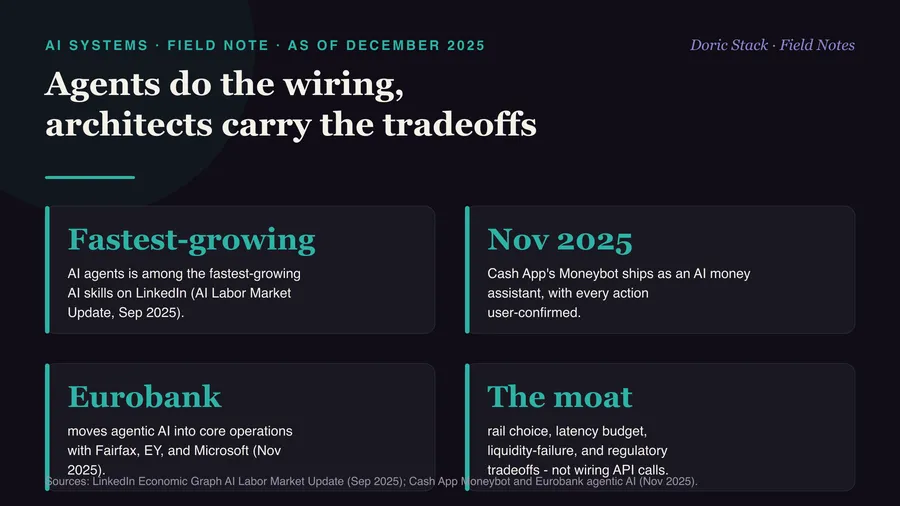
AI agents are arriving faster than most banking career ladders can adapt, and the market is already rewarding people who work with them. The career moat was never wiring up another API call. It is the judgment calls agents cannot own - which rail to trust, how much latency to spend, who the regulator will be.