Field note

RTP vs FedNow: the $10 million strategic divide

An $8M deal chopped into 16 payments because one bank used FedNow. With TCH-RTP at a $10M limit and FedNow at $500K, transaction size is quietly deciding which rail a corporate treasurer can use.

Jun 16, 2025 · Navin Agrawal · Payments · 3 min read

RTP vs FedNow: the $10 million strategic divide

Visual brief

Visual brief

RTP vs FedNow: the $10 million strategic divide

As of June 2025

A 20x transaction-limit gap between TCH-RTP and FedNow is quietly sorting banks - and their corporate customers - into a two-tier instant-payments system decided by transaction size.

An $8M commercial real estate deal got chopped into 16 separate payments this week because the buyer’s bank used FedNow, capped at $500K, while the seller expected one clean wire. A five-minute transaction became a three-hour coordination problem. That story is the whole strategic picture in miniature.

TCH-RTP limit

$10M

The Clearing House raised the TCH-RTP transaction limit to $10 million - built for high-value B2B and corporate disbursements.

FedNow limit

$500K

FedNow stayed at $500,000. A 20x gap that turns rail choice into a constraint on what a payment can even be.

The squeeze

Two-tier by size

Corporate treasurers now find their payment options depend on their bank technology choices, not their business requirements.

The instant-rails conversation usually gets framed as a technology race. It is not. Both rails clear in seconds. The thing actually separating them is a policy number: The Clearing House raised the TCH-RTP transaction limit to $10 million, and FedNow stayed at $500,000. That single gap is reshaping which institutions pick which rail, and which customers they can serve well.

The question is not which technology wins. It is whether this fragmentation serves customers, or just creates vendor lock-in by transaction size.

The divide, in one view

The original infographic for this note lays out the split: limits, ecosystem maturity, and the market-impact metrics behind the positioning.

The $10M strategic divide

Side-by-side rail positioning - limits, maturity, and the Q2-2024 market metrics - so the strategic split is visible at a glance rather than argued in prose.
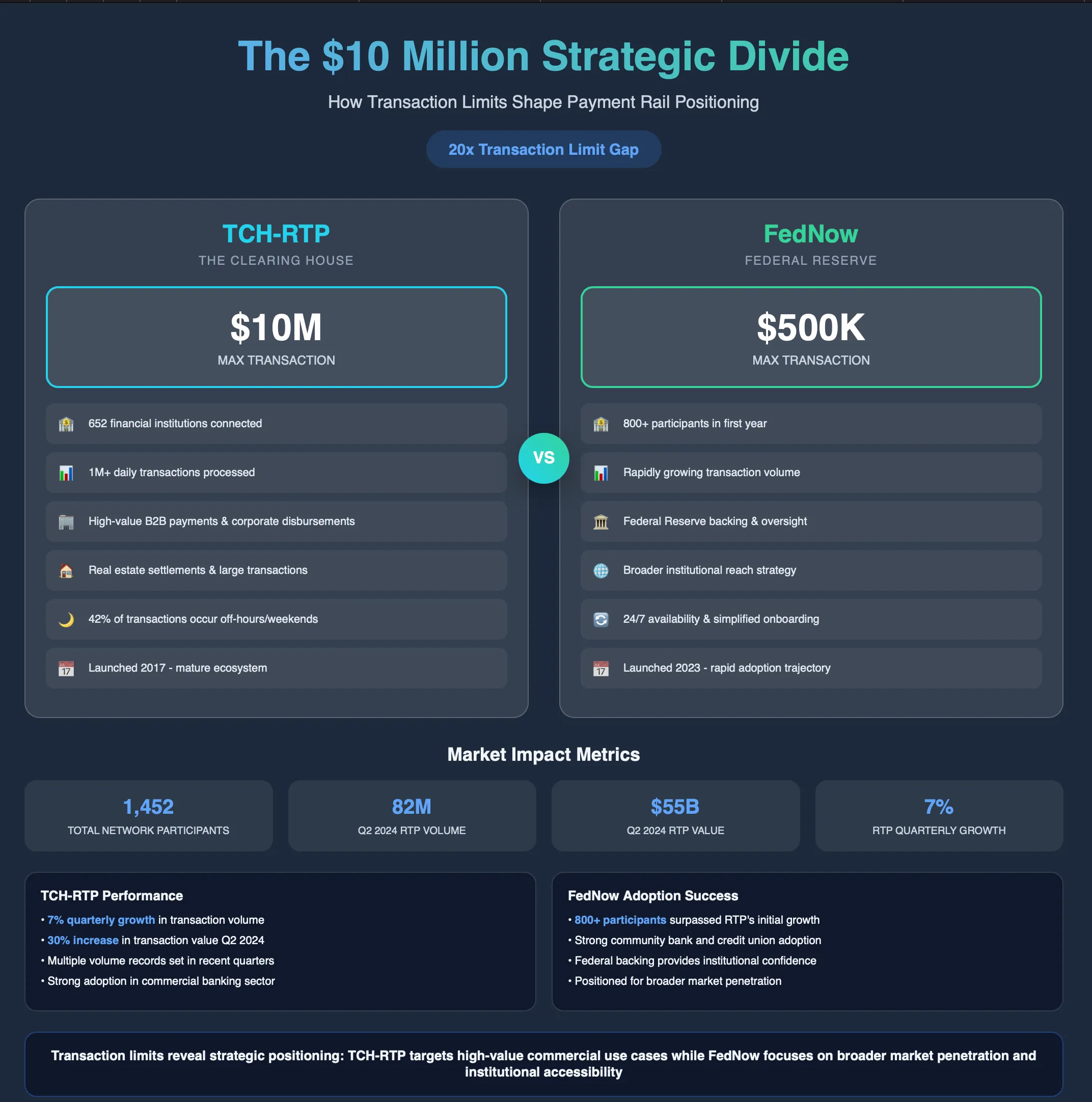
The $10 million strategic divide: TCH-RTP (The Clearing House) max transaction $10M, 652 financial institutions connected, 1M+ daily transactions, high-value B2B and corporate disbursements, 42% of transactions off-hours/weekends, launched 2017; FedNow (Federal Reserve) max transaction $500K, 800+ participants in first year, Federal Reserve backing, 24/7 availability and simpler onboarding, launched 2023. Market impact metrics: 1,452 total network participants, 82M Q2 2024 RTP volume, $55B Q2 2024 RTP value, 7% RTP quarterly growth.
The original artifact from this note: transaction limits, not settlement speed, are doing the strategic sorting.

The $10M strategic divide

The $10M strategic divide

The $10 million strategic divide: TCH-RTP (The Clearing House) max transaction $10M, 652 financial institutions connected, 1M+ daily transactions, high-value B2B and corporate disbursements, 42% of transactions off-hours/weekends, launched 2017; FedNow (Federal Reserve) max transaction $500K, 800+ participants in first year, Federal Reserve backing, 24/7 availability and simpler onboarding, launched 2023. Market impact metrics: 1,452 total network participants, 82M Q2 2024 RTP volume, $55B Q2 2024 RTP value, 7% RTP quarterly growth.

Why the gap creates a two-tier system

Large commercial banks are gravitating toward TCH-RTP because corporate clients need the high-value capability. When a manufacturer wants to pay $2M for equipment, splitting it into four payments is not professional. Per recent industry data from U.S. Bank, TCH-RTP now handles over 1 million daily transactions, with 42% happening outside business hours - the shape of real corporate and consumer demand, not a pilot.

Community banks, meanwhile, appreciate FedNow’s federal backing and simpler onboarding. But they are discovering their business customers are larger than expected, which puts those customers on the wrong side of the $500K line. The corporate treasurer ends up caught in the middle: their available rail now depends on their bank’s technology choice, not on what their business actually needs to move.

A Payments Dive analysis frames where this leads: a two-tier system where transaction size determines which rail you can use. That feels backward. The rails were supposed to expand what payments could do, not quietly decide them by which institution you happen to bank with.
Was this useful?

Choose once.

Related Posts

View All Posts »
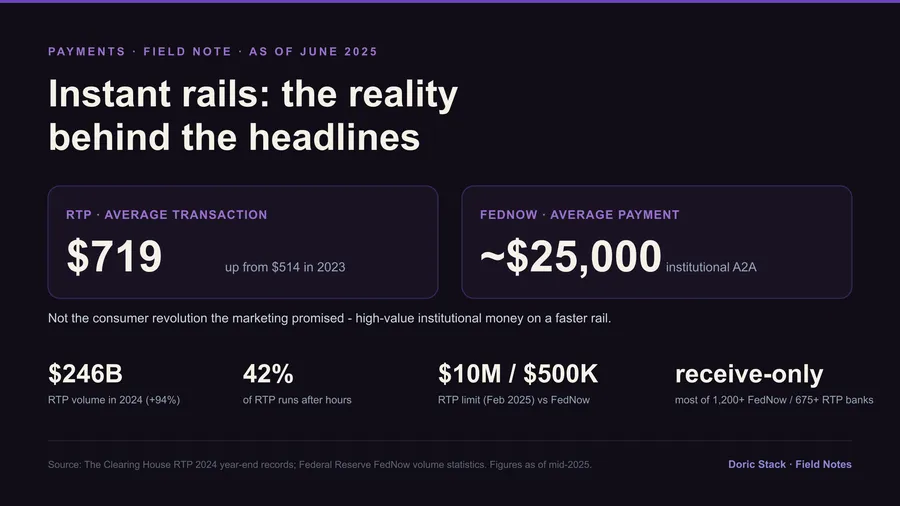
Instant rails: the reality behind the marketing

Instant rails: the reality behind the marketing

RTP cleared $246 billion in 2024 and the headlines said instant payments had arrived. The average transaction sizes tell a quieter story - this is high-value institutional money on a faster rail, not the consumer revolution that was promised.

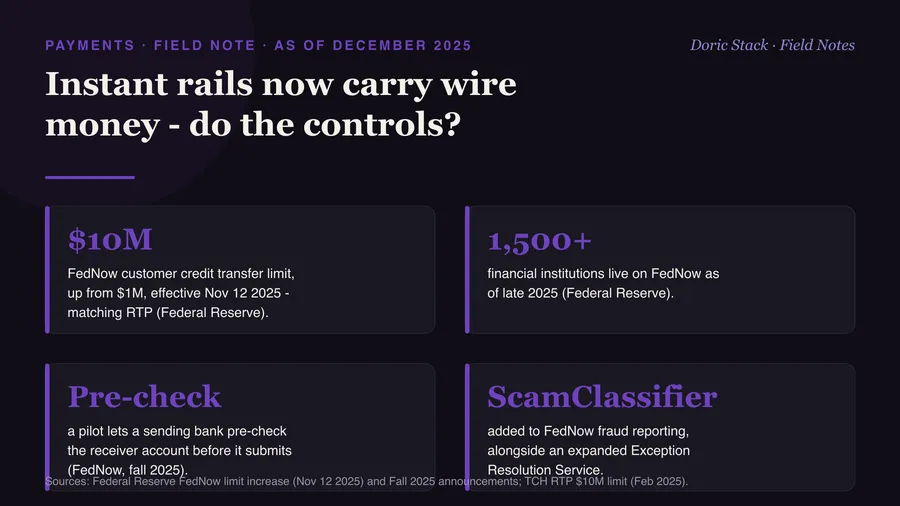
Instant rails now carry wire money. Do the controls?

Instant rails now carry wire money. Do the controls?

FedNow matched RTP at a $10M network limit in November 2025 and added new risk rails - a receiver-account pre-check pilot, ScamClassifier reporting, an Exception Resolution Service, and 1,500+ banks live. Instant is treasury cash now, and batch-era controls just got a 24/7 bypass.

Under a second is the right answer to the wrong question

Under a second is the right answer to the wrong question

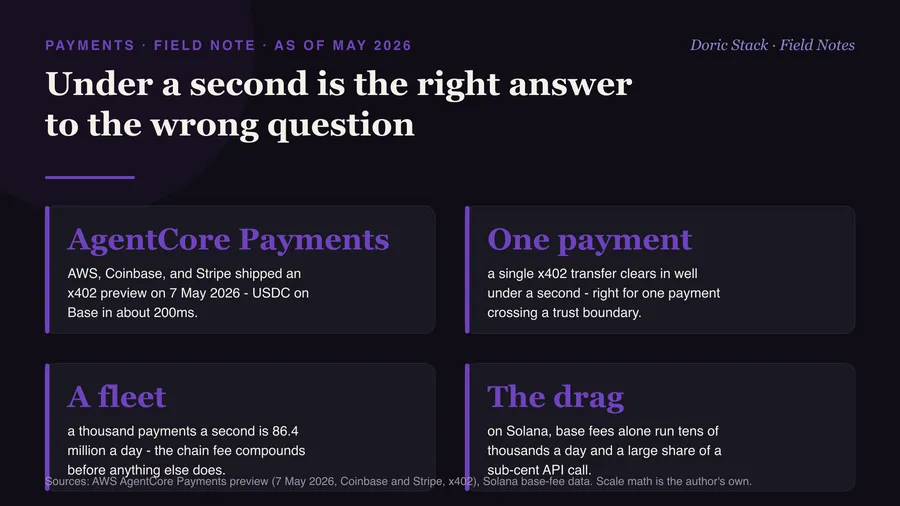
At an AWS Bedrock AgentCore Payments session the question was what happens at a thousand transactions a second, and the answer was settlement in under a second. Both are true and they answer different questions. The right frame for one payment crossing a trust boundary is the wrong frame for a million events a day inside one agent fleet, where the chain fee stacks up before anything else does.

Payment modernization stalls at security review, not architecture

Payment modernization stalls at security review, not architecture

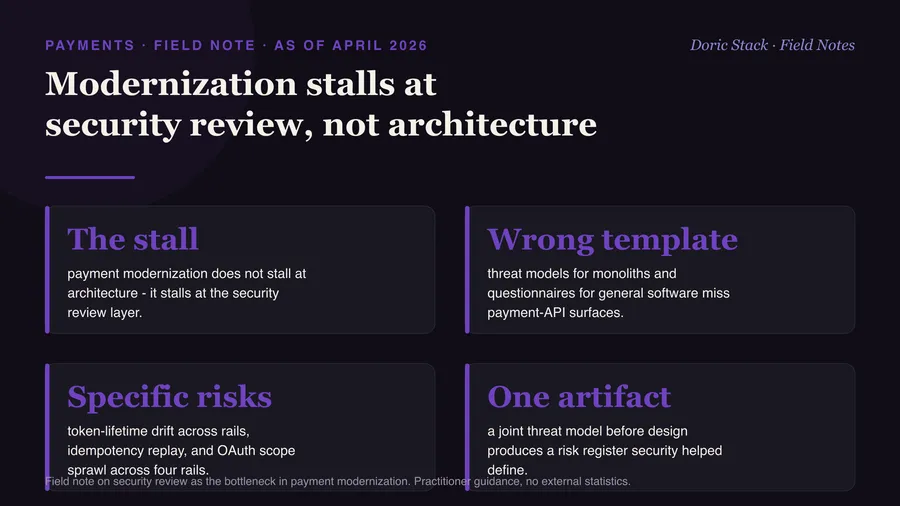
Payment modernization projects do not stall at the architecture layer. They stall at the security review layer - threat models built for monoliths, questionnaires written for general software, cycles tuned for annual releases. The teams that ship on time put security in the room before design, not after.