
As of September 2025
Your HCM client just called. They need to reverse payroll for 200 employees across three states, from three weeks ago. Your virtual-account system either handles that gracefully or operations spends the weekend doing it by hand.
A virtual-account hierarchy that mirrors business reality - client companies on top, cost centers beneath, employees at the bottom - reads as simple on a whiteboard. Then come mergers, employee transfers between entities, and retroactive corrections that cross fiscal boundaries, and the simple structure becomes a compliance maze.
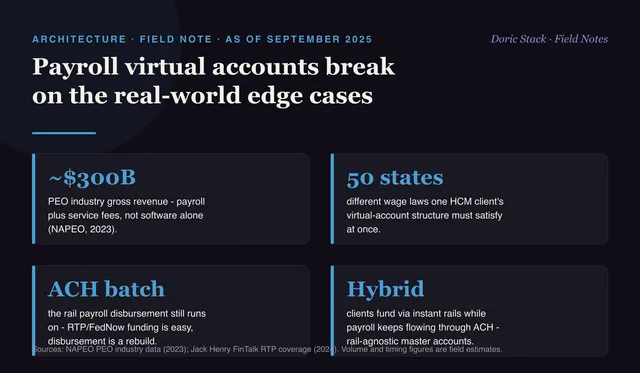
The stakes are not small. The PEO industry alone runs into the hundreds of billions in gross revenue - payroll dollars plus service fees bundled together - and a single client managing workers across all 50 states drags 50 sets of wage law into one account structure. The data model that survives is the boring one: entity relationships with effective dates, an audit trail for every balance movement, and settlement rules that know operating funds from tax escrow.
Funding is the easy half
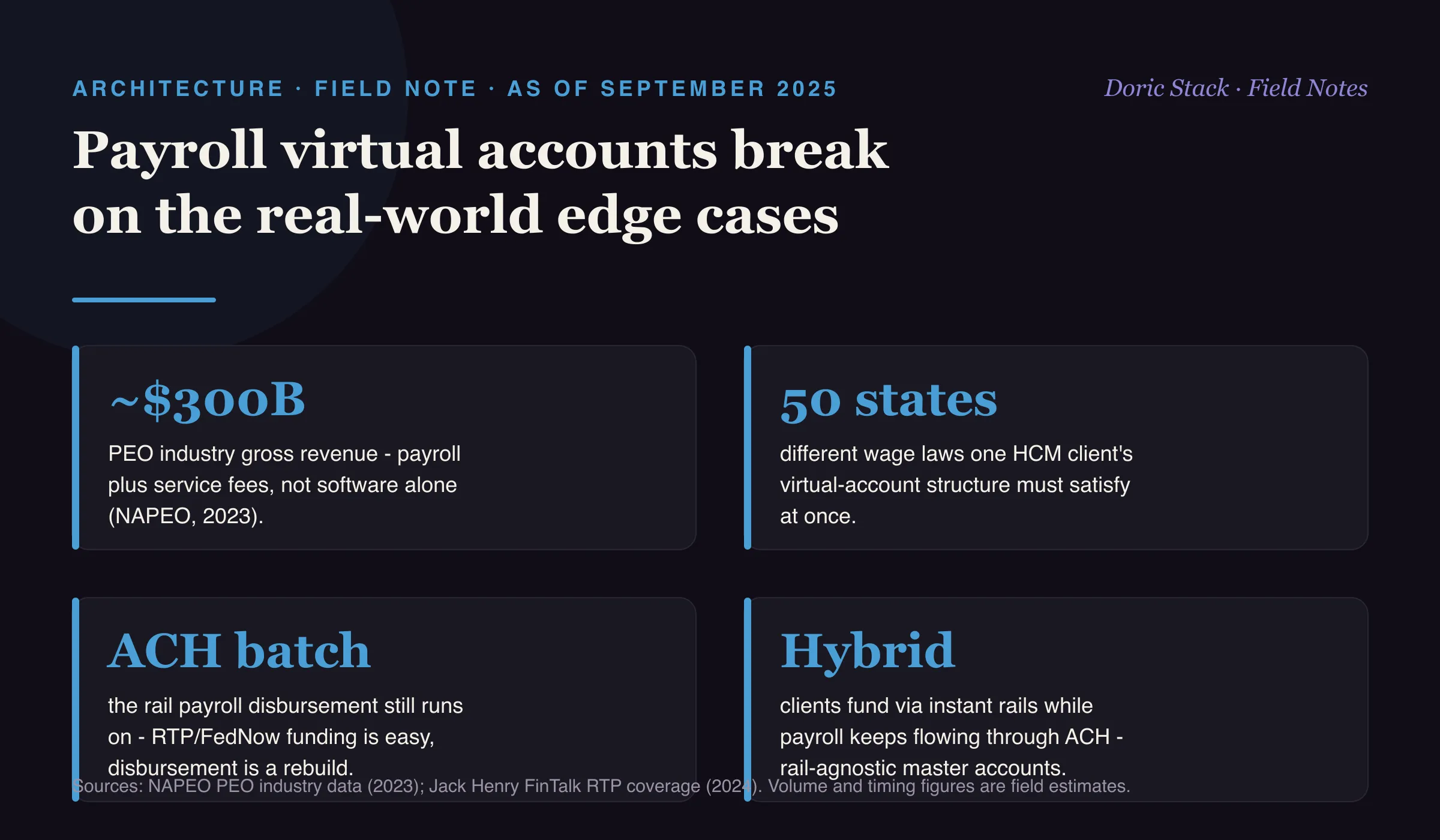
Instant deposits land in the same master accounts the ACH processors already monitor, so RTP and FedNow funding needs no real architecture change. A client can push money in on instant rails today and nothing downstream has to move.
Disbursement is the rebuild
Payroll goes out through dedicated ACH processors built around employee data and regulatory reporting, and those systems do not do instant transactions. Moving disbursement to RTP means rebuilding that processing layer, not flipping a flag.
Clients can fund on instant rails while payroll keeps flowing through ACH batch. The master accounts have to be rail-agnostic, and disbursement stays batch-oriented for now.