
As of February 2026
A duplicate payment in live production is not an edge case. It is how a treasury control plane shows you what you have not modeled yet.
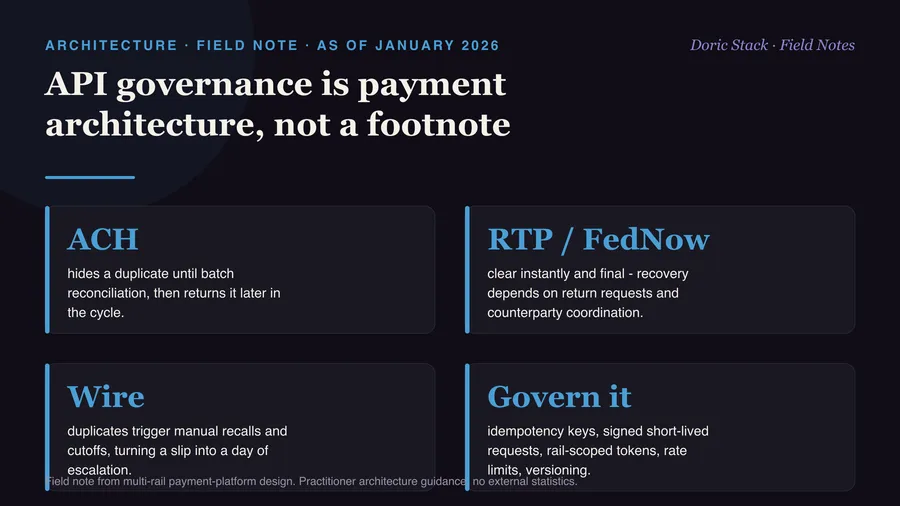
Most teams think in API semantics - retry, timeout, recovery. In payments that framing is already too late. The same request, retried after a transport timeout, can land as a final success on one rail and a settlement reject on another, look clean on dashboard health, and still have the operations floor move two accounts twice within minutes.
Why best-effort dedupe fails
A duplicate is not caught by hope. When automation depends on best-effort dedupe, money movement is exposed at exactly the seam where the rails disagree - one says final, the other says rejected, and the status drift between them is where the second debit hides. The fix is to make a duplicate outcome impossible to hide, not merely unlikely.
A deterministic mesh
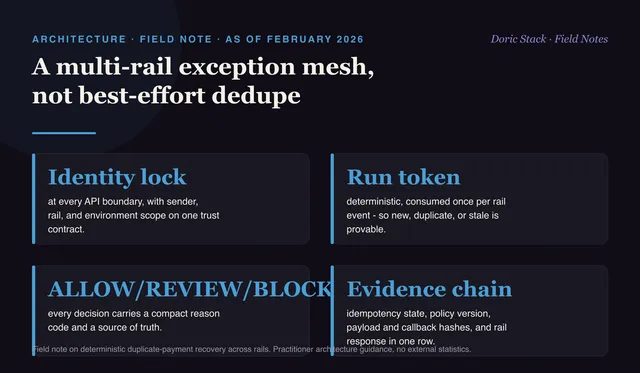
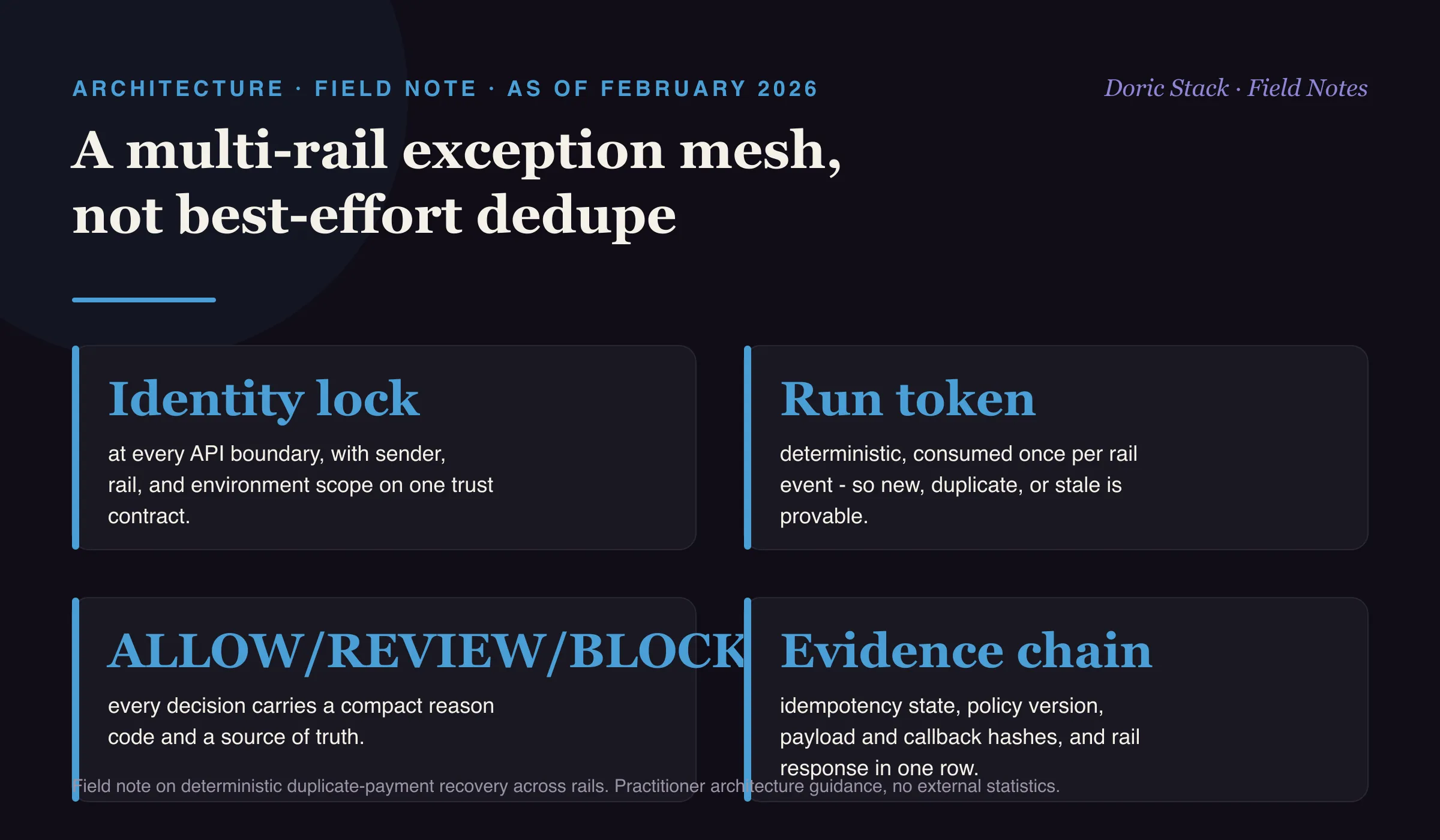
Put an identity lock at every API boundary, tying sender, rail, and environment scope to one trust contract. Use a deterministic run token that survives worker restarts and is consumed exactly once per rail event, so you can prove whether a request was new, duplicate, or stale. Route every decision through ALLOW, REVIEW, or BLOCK lanes, each carrying a reason code and a source of truth. And split exceptions by event type - duplicate, stale callback, beneficiary mismatch, insufficient liquidity - because each needs a different action and owner.
Run token
Consumed once
a deterministic token consumed exactly once per rail event, so new, duplicate, or stale is provable.
Policy lanes
ALLOW/REVIEW/BLOCK
every decision carries a compact reason code and a clear source of truth.
Evidence chain
One ledger row
idempotency state, policy version, payload and callback hashes, and rail response together.
Teams fix incidents after the fact and call it resilience. Better systems stop the bad state at the seam where intent becomes money movement.