
As of April 2026
A cross-border team walks into its ISO 20022 remediation meeting thinking it is on track. Ninety minutes later the meeting is over and the data governance lead is on the phone.
The translator is ready. The mapping is tested. The structured fields are wired. The code is not the problem. It is the customer records: missing structured address data across KYC, core banking, and correspondent files, with the rails about to start rejecting unstructured messages.
Why it is a migration, not a milestone
Most banks frame mid-November 2026 as an ISO 20022 messaging milestone. The banks shipping on time treat it as a data migration, because the messaging change is the easy part. SWIFT itself reported in early 2026 that around 65 percent of CBPR+ payment messages still carry unstructured addresses, which is a data-quality problem, not a protocol problem. Three questions separate the ready from that 65 percent. Where does the unstructured data live - usually four teams with four owners across KYC, core banking, correspondent files, and ERP senders. Who owns remediation when parsing is ambiguous, because “Main Street, London” has several valid structured interpretations and a messaging team cannot adjudicate that. And what is the fallback when a counterparty sends unstructured - reject, transform, or escalate, each with a different SLA impact.
The deadline is not one date
It is a cluster. SWIFT starts rejecting fully unstructured cross-border addresses on November 14, 2026, with SEPA on the 15th and CHAPS on the 13th. The week of November 13 to 15 is the cliff, and a hybrid structured address with at least town and country is the minimum each rail will accept.
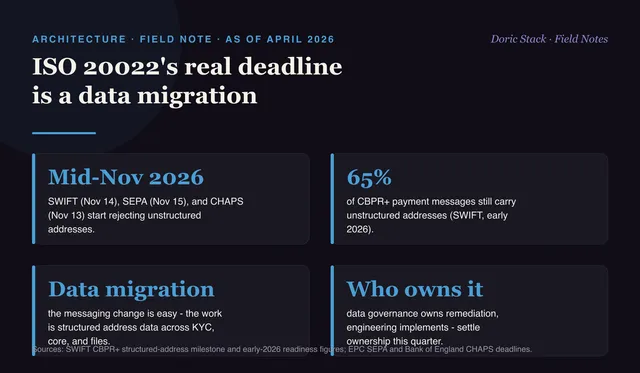
The cliff
Mid-Nov 2026
SWIFT (Nov 14), SEPA (Nov 15), and CHAPS (Nov 13) begin rejecting unstructured addresses.
Readiness gap
65%
of CBPR+ payment messages still carry unstructured addresses (SWIFT, early 2026).
The real work
Data migration
the messaging change is easy - the work is structured address data across KYC, core, and files.
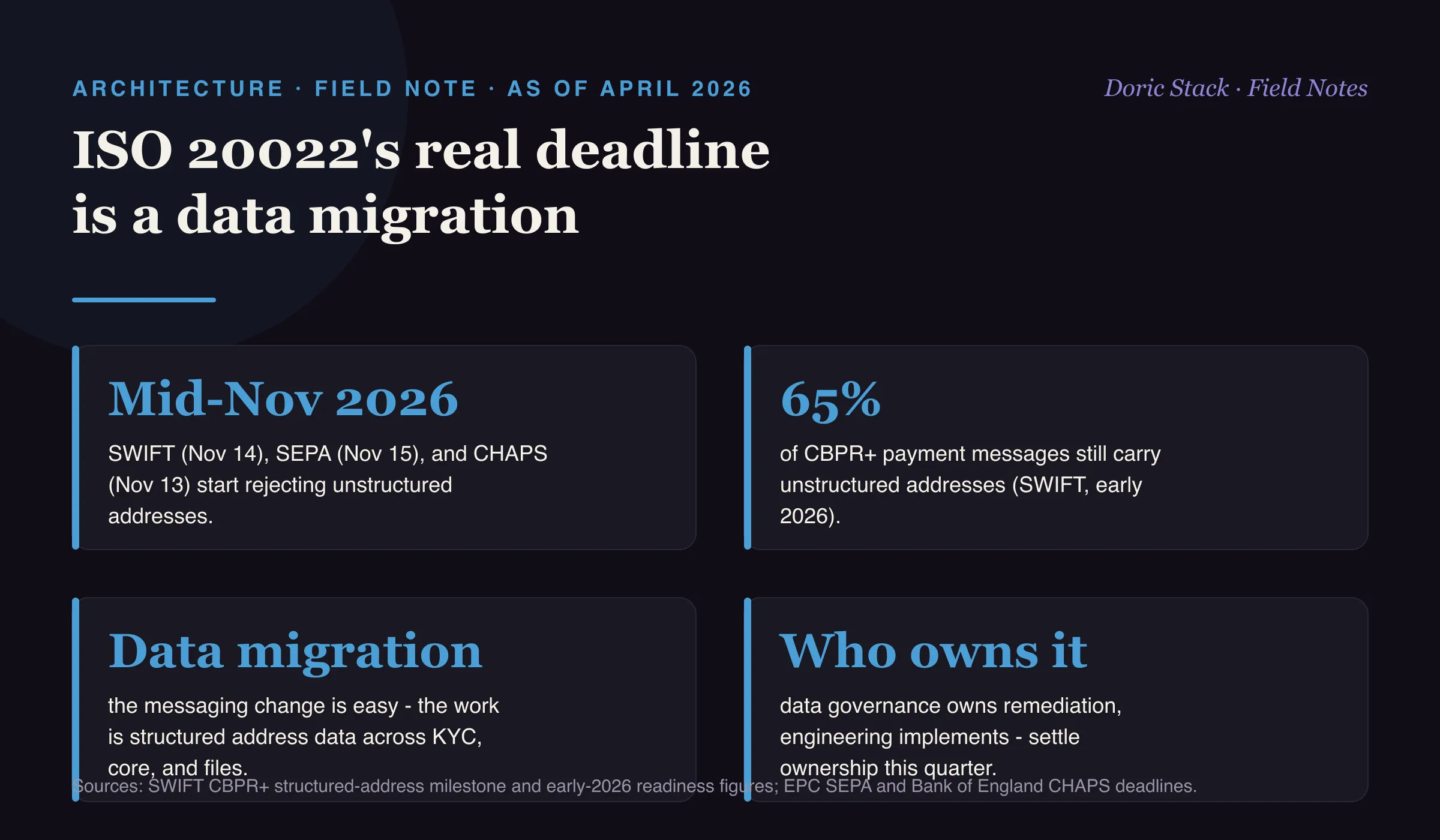
On every compliance cliff I have seen ship clean, the same pattern holds: data governance owns remediation, engineering implements. The banks settling data ownership this quarter are the ones who ship.