Field note

Variable recurring payments reset the subscription rail

Subscription billing has two bad options today - store the card or chase a manual approval every cycle. Variable recurring payments add a third: pre-authorized variable amounts with limits enforced by the rail. The UK is building it now, and the lesson for everyone else is about regulatory cycles, not technology.

Nov 3, 2025 · Navin Agrawal · Strategy · 3 min read

Variable recurring payments reset the subscription rail

Visual brief

Visual brief

Variable recurring payments reset the subscription rail

As of November 2025

Variable recurring payments solve the problem subscription billing has always had. Netflix charges the same amount monthly, but utilities, cloud bills, and usage-based services change every cycle.

The only ways to handle variable billing today are storing a card, which is a compliance burden, or asking for manual approval every time, which is an abandonment problem. VRPs add a third option: a customer authorizes “charge me up to $500 a month,” and the payment rail enforces the limit.

How a VRP works

The consent lives at the rail, not the merchant. The customer sets the cap, the frequency, and the amount ceiling at authorization, and the bank enforces them on every charge. No stored card, no manual approval each cycle, and no 3 AM fraud alert because a model flagged a legitimate $487 bill as unusual. It is pre-authorized and bounded, which is exactly what variable billing needs.

Where the UK actually is

Despite the headlines, this is a phased, industry-led rollout, not a blanket mandate. A new industry body backed by 31 firms was being stood up through 2025 under the FCA and PSR, with Phase 1 aimed at utilities, government, and financial services, and first live commercial payments expected in 2026. The direction is set. The calendar is slower than the slideware suggests.

The third option

Pre-authorized

variable amounts with rail-enforced limits - no stored cards, no manual approval each cycle.

UK scope

Phase 1

non-sweeping VRPs target utilities, government, and financial services (FCA and PSR).

First live payments

2026

expected for UK commercial VRPs, via an industry initiative of 31 firms.
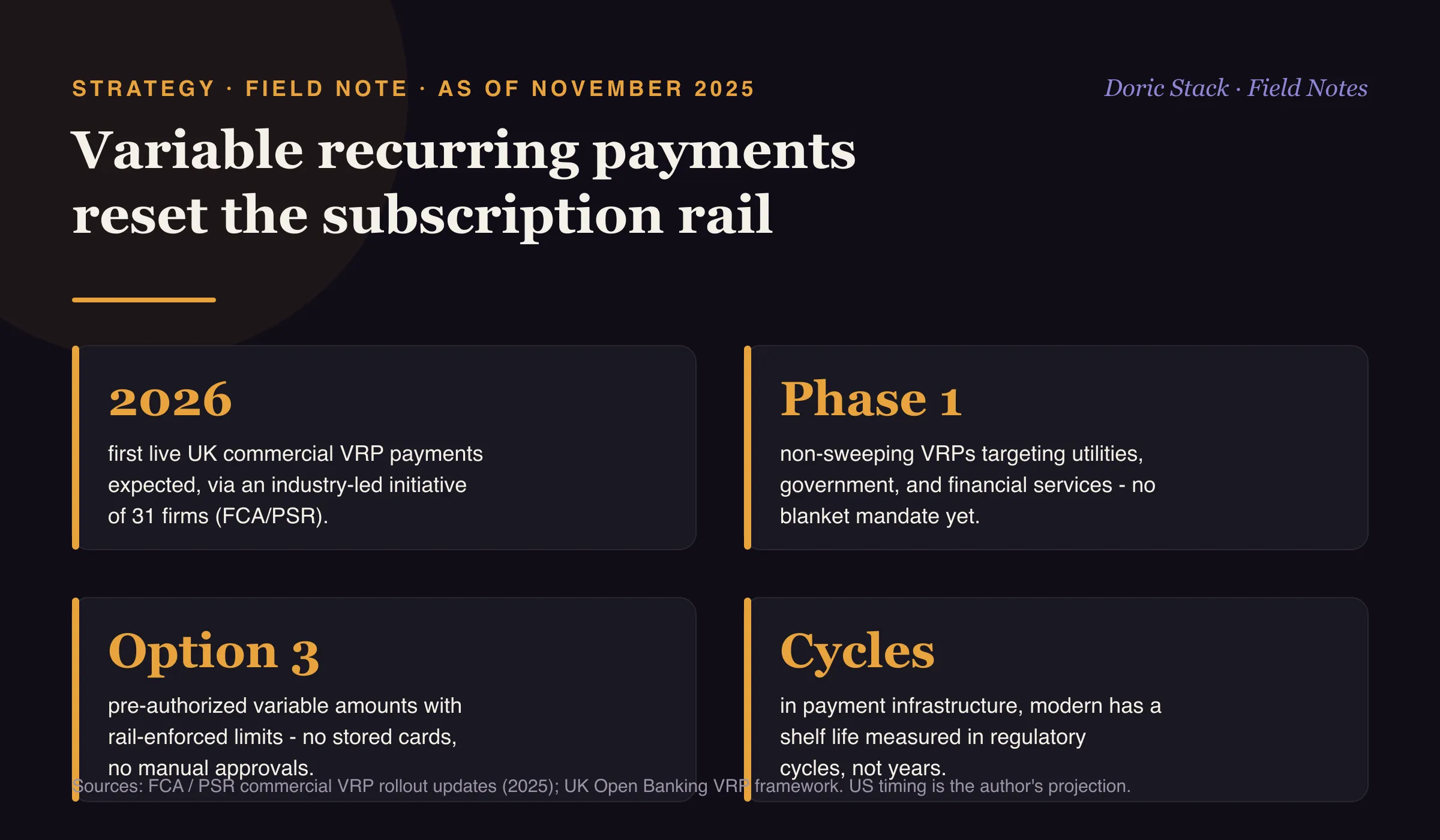
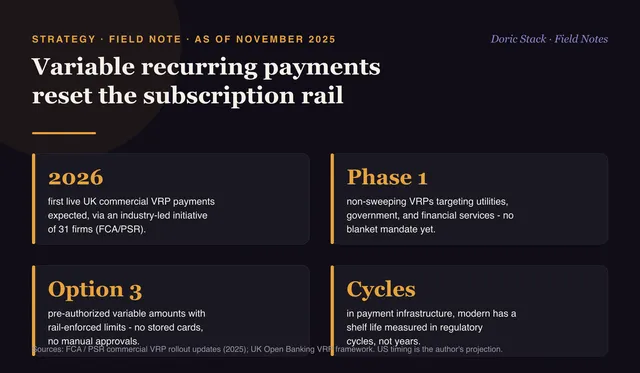
Variable recurring payments reset the subscription rail (as of November 2025): first live UK commercial VRP payments are expected in 2026, via an industry-led initiative of 31 firms under the FCA and PSR; Phase 1 non-sweeping VRPs target utilities, government, and financial services, with no blanket mandate yet; the model is pre-authorized variable amounts with rail-enforced limits, meaning no stored cards and no manual approvals; and in payment infrastructure, modern has a shelf life measured in regulatory cycles, not years.
A third option for variable billing - bounded, pre-authorized, enforced at the rail rather than by the merchant.
In payment infrastructure, 'modern' has a shelf life measured in regulatory cycles, not years. The instant-rails platform finished in 2022 is already a step behind.
Was this useful?

Choose once.

Related Posts

View All Posts »
The operating model kills payment modernization, not the tech

The operating model kills payment modernization, not the tech

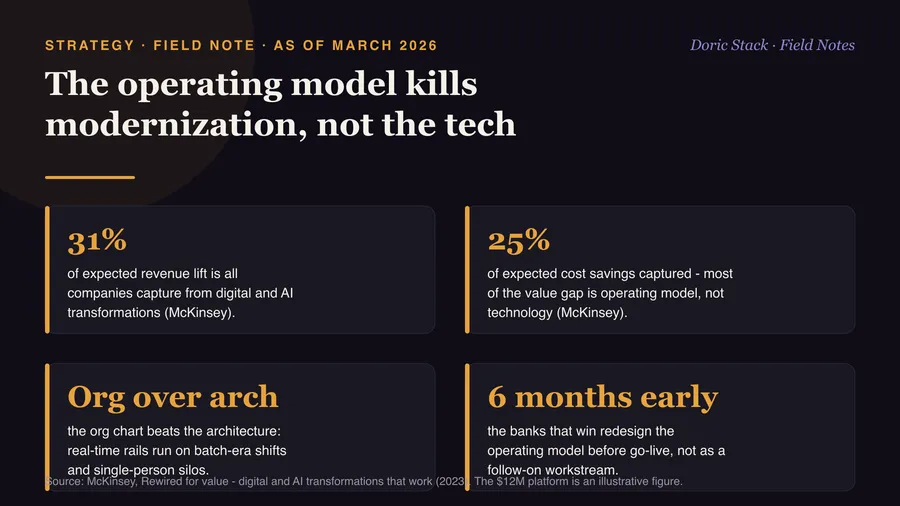
A bank buys a modern payment platform and keeps the 2019 team structure, the same escalation matrix, the same three-person on-call rotation. The platform ships daily. The governance model says 90 days. Most modernization failures are operating-model failures, and the org chart defeats the architecture every time.

Design open banking for the rule that keeps moving

Design open banking for the rule that keeps moving

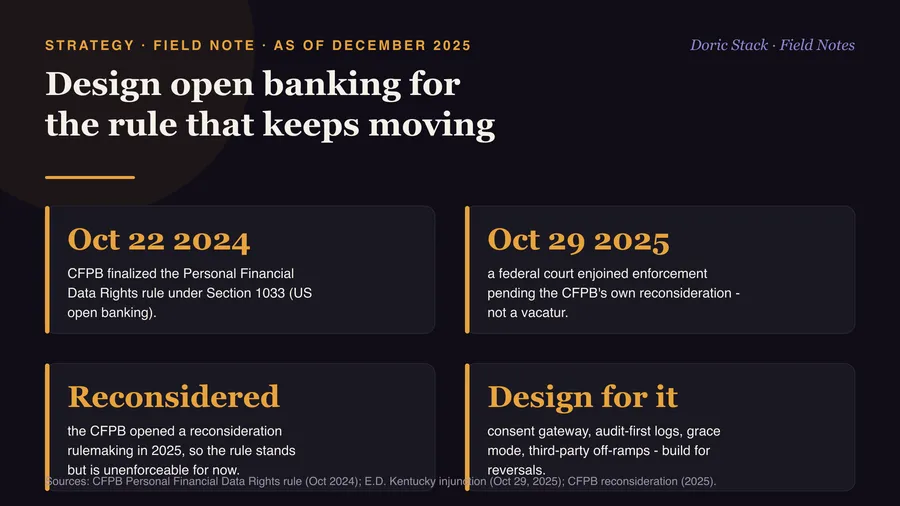
The CFPB finalized US open banking under Section 1033 in October 2024, a federal court enjoined enforcement a year later, and the rule is now back in reconsideration. The data layer that survives that whiplash is the deliverable, not the API. Build for reversals, not launch day.

Euro payments now name-check the payee before they move

Euro payments now name-check the payee before they move

Since October 2025, euro credit transfers run a Verification of Payee check before they settle, and a name-IBAN mismatch triggers an alert. It hits US treasuries paying EUR vendors and payroll as hard as it hits EU banks, and the same name checks are a fair bet to reach FedNow and RTP next.

Real-time payments break your treasury org chart before they break your tech

Real-time payments break your treasury org chart before they break your tech

Your real-time rails settle in fifteen seconds. Your treasury org chart was built around an end-of-day cutoff. The gap between them is where the next reconciliation loss lives, and it shows up in three roles - cash positioning, exception ops, and intraday risk - long before it shows up in the tech stack.