
As of March 2026
Every payment platform has API documentation. Almost none of them have a developer experience. Integration starts the same way: a PDF, a sandbox that takes days to provision, and a support email that answers in 48 hours.
Onboard enough partners and you learn the third support email is where patience dies and a competitor gets Googled. So I built a self-service workbench to remove that wait, and the friction it removes is the friction that actually loses integrations.
What it does
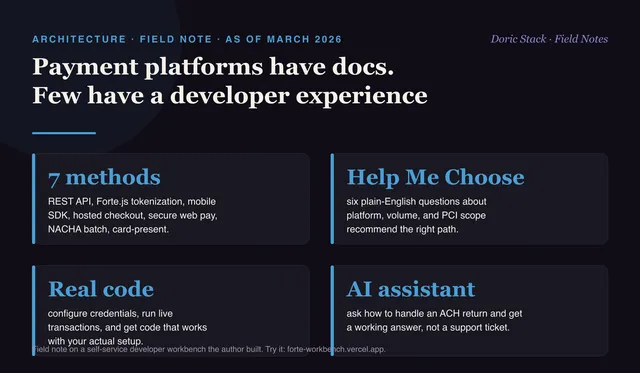
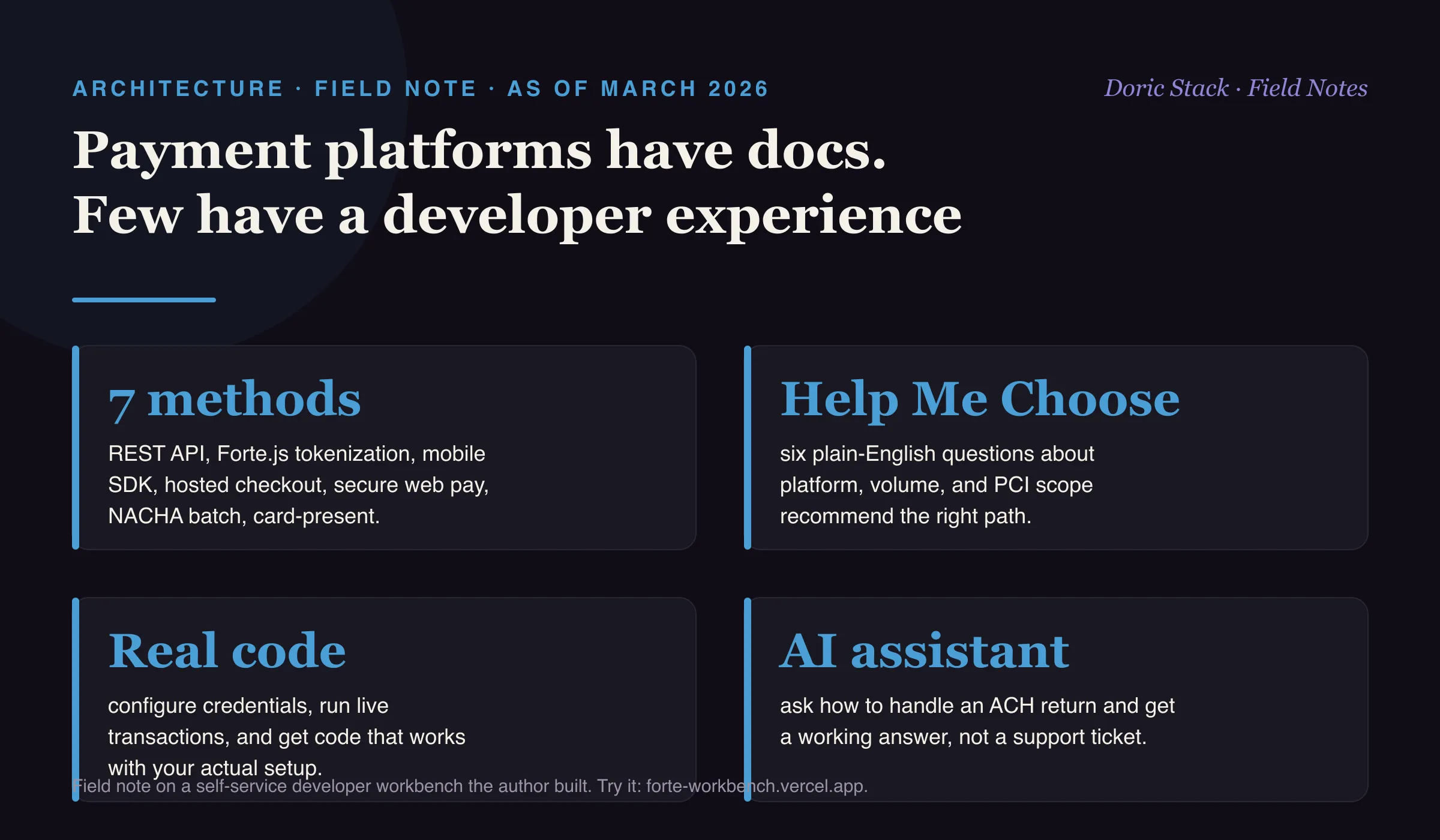
The workbench covers seven integration methods in one place - REST API, Forte.js tokenization, a mobile SDK, hosted checkout, secure web pay, NACHA batch, and card-present devices. If you do not know which one fits, a “Help Me Choose” flow asks six plain-English questions about your platform, your volume, and your PCI scope, then recommends a path. You pick a method, configure real credentials, run live transactions, and get code that works with your actual setup rather than generic samples from a docs page.
Not only for new builds
Existing clients can load their own credentials and test against sandbox or production. Debug a declined transaction, simulate error codes, verify a batch-file format, or ask the AI assistant an integration question in plain English. “How do I handle an ACH return” returns a working answer instead of a support ticket. The point is to let a developer get unstuck without waiting on a queue.
Integration paths
7 methods
REST API, Forte.js tokenization, mobile SDK, hosted checkout, secure web pay, NACHA batch, card-present.
Path finder
Help Me Choose
six plain-English questions about platform, volume, and PCI scope recommend the right path.
Output
Real code
configure credentials, run live transactions, and get code that works with your actual setup.
Twenty-plus years on the architecture side of payments, and the hardest part was never the infrastructure. It was the distance between what the platform can do and what a developer can figure out alone.