
As of November 2025
Your bank's email says it is ISO 20022 ready for the November 22 cutover. Open the implementation docs and it is usually a translation layer: MT converting to MX at the SWIFT boundary, then back to MT for the systems inside.
That is technically compliant. It is also where the value leaks out, because the structured data ISO 20022 carries does not survive the round trip back into MT.
Coexistence ends
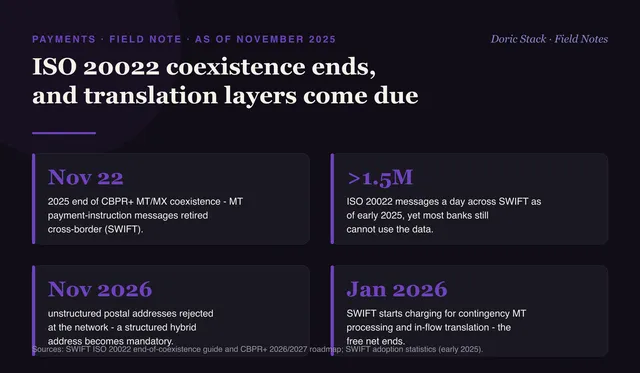
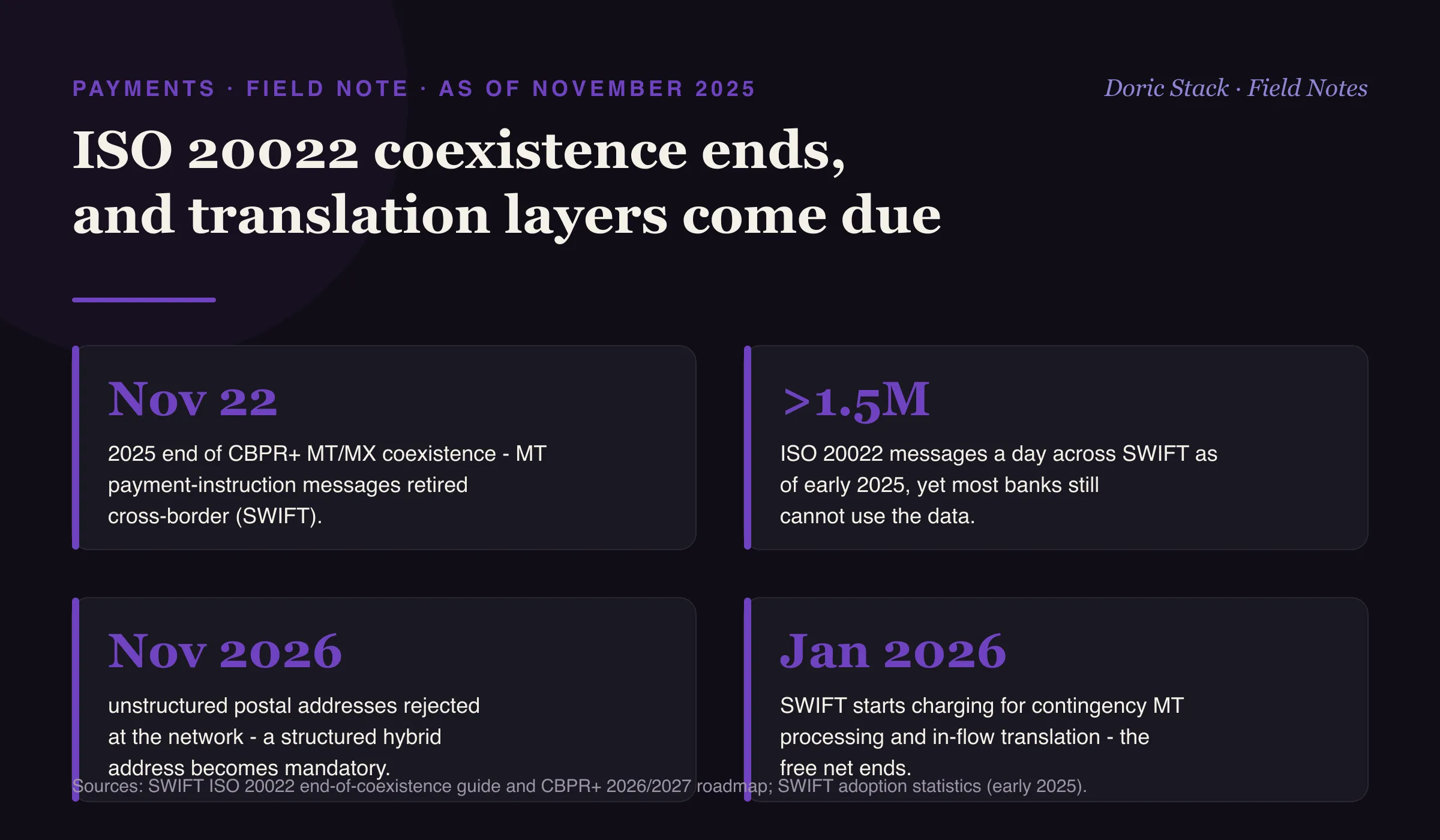
Nov 22
2025 end of CBPR+ MT/MX coexistence - MT payment-instruction messages retired cross-border (SWIFT).
Structured address
Nov 2026
unstructured postal addresses rejected at the network, with a structured hybrid address mandatory.
Free net ends
Jan 2026
SWIFT starts charging for contingency MT processing and in-flow translation.
What the translation layer drops
A structured remittance field rich enough to carry invoice detail gets flattened when it lands in an MT-based reconciliation system, and the treasury team goes back to manual matching. Enriched party identifiers with Legal Entity Identifiers that would make sanctions screening automatic get truncated, so compliance validates by hand what should have been automated. Structured exception codes the translation layer cannot interpret turn every edge case into a manual investigation.
The deadlines stacking up behind it
The architecture question banks deferred in 2023 and 2024 is now a multi-year problem. From January 2026, SWIFT starts charging for contingency MT processing and in-flow translation. From November 2026, unstructured postal addresses are rejected at the network. By November 2027, free-format investigation messages give way to ISO 20022 Case Management. The translation layer depends on exactly the things SWIFT is retiring.
Technical compliance and competitive advantage are not the same thing. The banks running native ISO 20022 already have the straight-through reconciliation the translation layer cannot deliver.