Field note

Banking's authentication crisis: AI defeated the voiceprint

Sam Altman told a Fed conference that AI has defeated most of the ways people authenticate today - voiceprints especially, clonable from a few seconds of audio. The fix is not a better voice system; it is rebuilding authentication around device-bound cryptographic keys.

Jul 23, 2025 · Navin Agrawal · Payments · 3 min read

Banking's authentication crisis: AI defeated the voiceprint

Visual brief

Visual brief

Banking's authentication crisis: AI defeated the voiceprint

As of July 2025

When the OpenAI CEO tells a room of bankers that AI has already beaten most of how people authenticate, the takeaway is not to harden voice systems. It is that an entire category of authentication is finished.

At a Federal Reserve conference on 22 July 2025, Sam Altman warned that “AI has fully defeated most of the ways that people authenticate currently other than passwords” - aimed squarely at the voiceprint systems some banks still accept. Modern voice cloning needs only a few seconds of audio to pass them.

The detail that should worry every bank: this was not a researcher’s hypothetical. Voice authentication that banks spent millions deploying is being bypassed by tools that clone a voice from a roughly three-second clip. When the Fed’s own Vice Chair for Supervision, Michelle Bowman, responded by floating partnerships with AI firms to help identify impersonations and deepfakes, it confirmed that the incumbent authentication stack is treated as broken, not patchable.
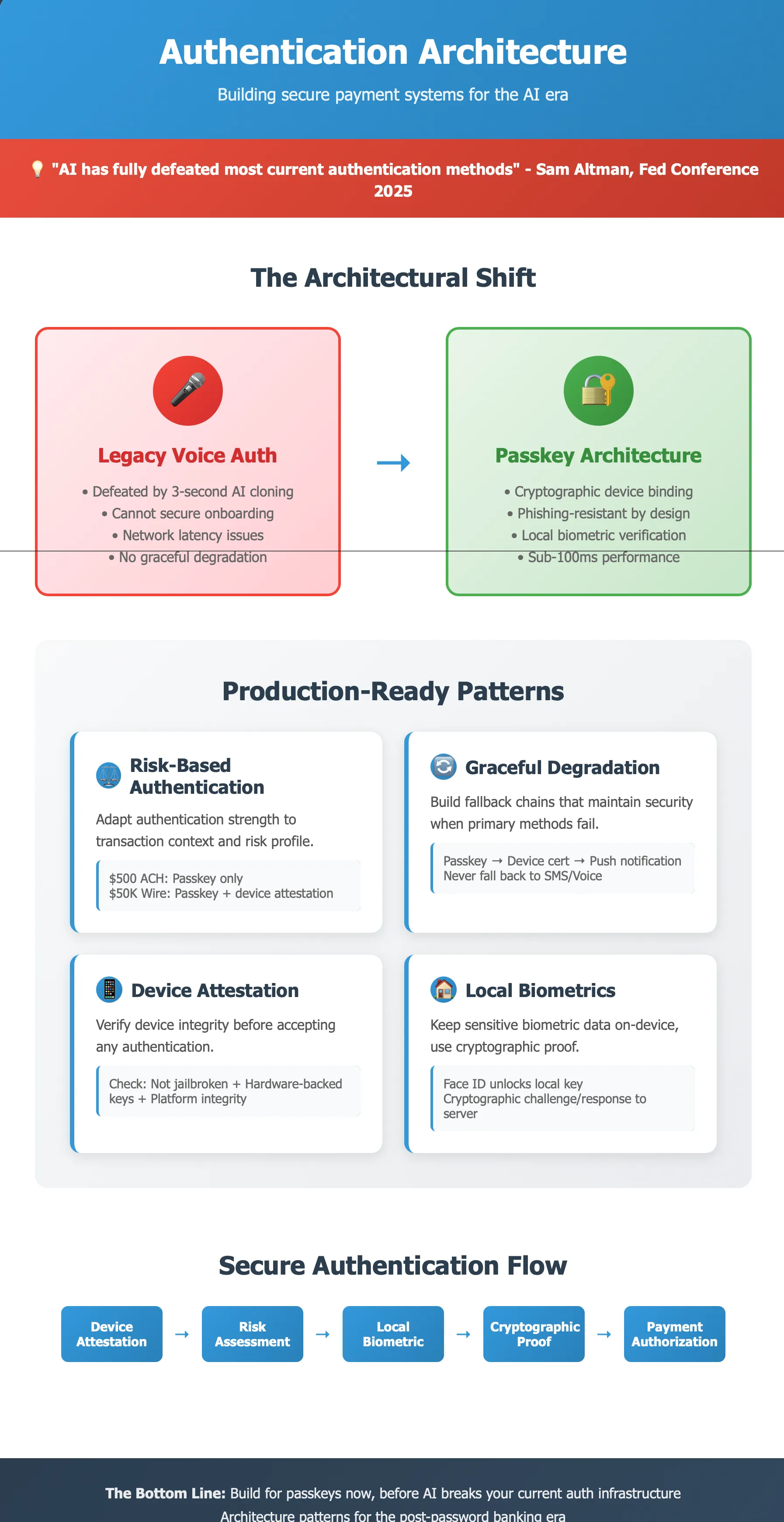
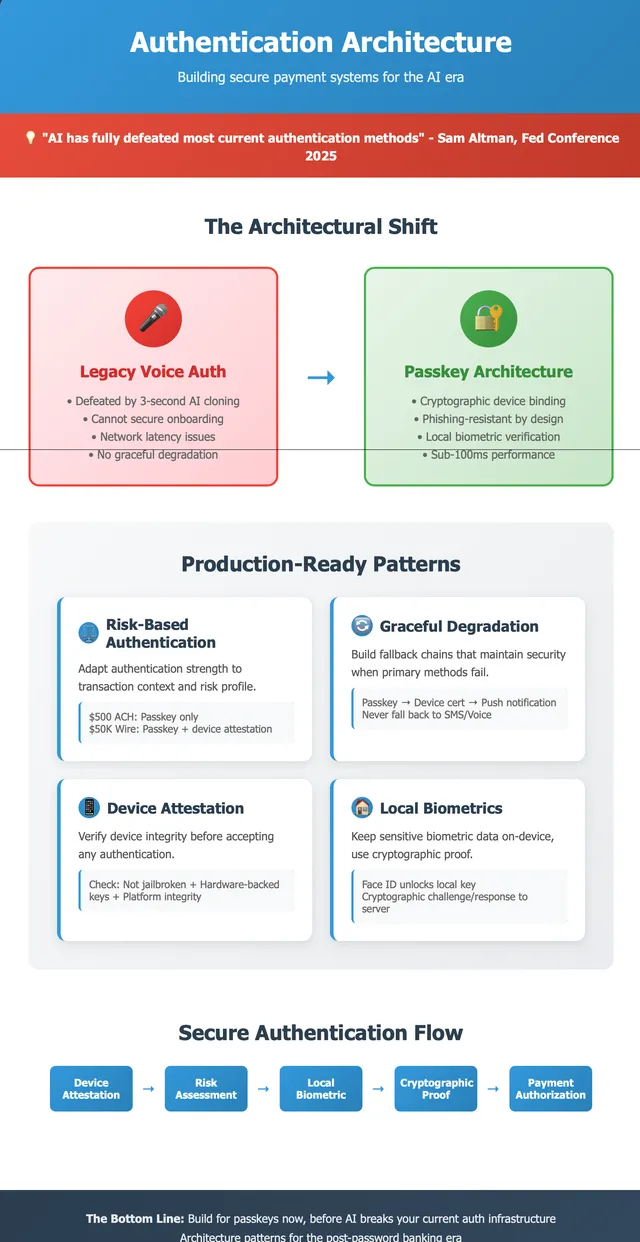
Banking's authentication architecture shift (as of July 2025): legacy voice authentication (defeated by 3-second AI voice clones, no graceful degradation) gives way to passkey architecture (device-bound cryptographic keys, phishing-resistant, local biometric verification, sub-100ms performance). Production-ready patterns: risk-based authentication adapting to transaction context, graceful degradation that never falls back to SMS or voice, device attestation, and local biometric verification where the device unlocks the passkey and no biometric data travels the network. Source: Sam Altman, Federal Reserve conference, July 2025.
The replacement is already specified: device-bound cryptographic keys, not a better way to listen to a voice.

The replacement architecture is not exotic - passkeys use device-bound cryptographic keys instead of a shared secret or a sound the attacker can synthesize. But swapping authentication methods on a payment platform is an infrastructure problem as much as a security one, because real-time authorization still needs sub-100ms responses. The design has to be fast and resilient at the same time.

What is being retired

Voiceprints and any “something you sound like” factor. They are now an open door: a few seconds of recorded audio is enough to clone the credential, and no amount of “enhanced” voice modeling closes a gap that is fundamental to the method.

What replaces it

Risk-based, layered auth. A routine $500 ACH gets a passkey check; a $50K wire to a new beneficiary gets stepped up. Graceful degradation falls back to device-bound certificates and cryptographic push - never to SMS or voice. Biometrics stay local: the device unlocks the passkey, and no biometric data crosses the network.

The fix is not a better voice system. It is rebuilding authentication around keys that cannot be cloned from a recording - and doing it before the next breach forces the issue.
Was this useful?

Choose once.

Related Posts

View All Posts »
Under a second is the right answer to the wrong question

Under a second is the right answer to the wrong question

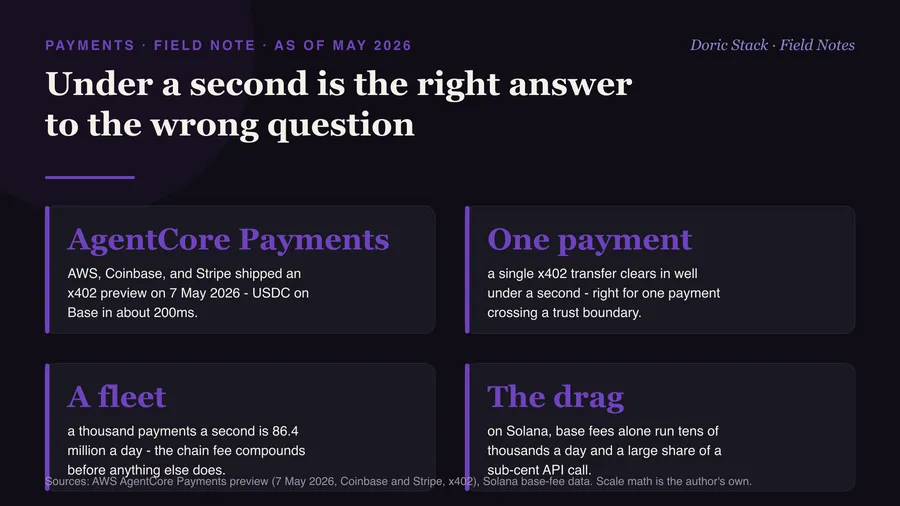
At an AWS Bedrock AgentCore Payments session the question was what happens at a thousand transactions a second, and the answer was settlement in under a second. Both are true and they answer different questions. The right frame for one payment crossing a trust boundary is the wrong frame for a million events a day inside one agent fleet, where the chain fee stacks up before anything else does.

Payment modernization stalls at security review, not architecture

Payment modernization stalls at security review, not architecture

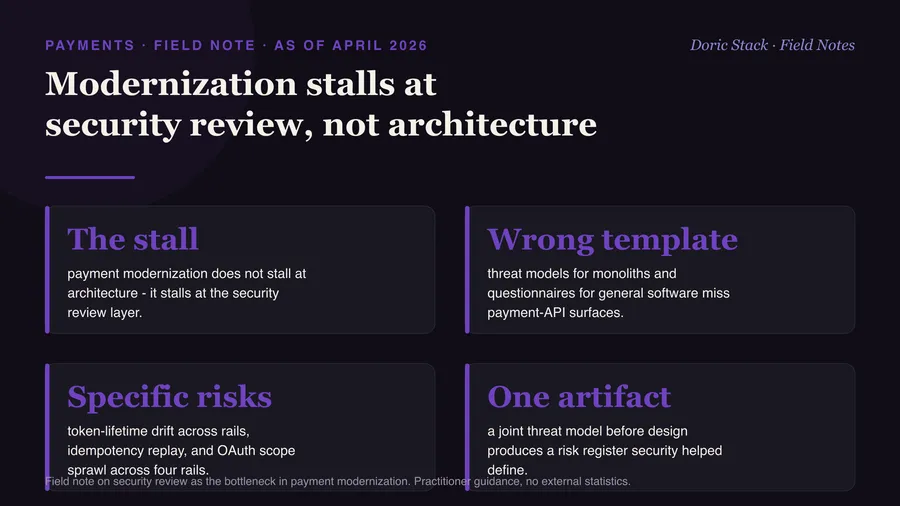
Payment modernization projects do not stall at the architecture layer. They stall at the security review layer - threat models built for monoliths, questionnaires written for general software, cycles tuned for annual releases. The teams that ship on time put security in the room before design, not after.

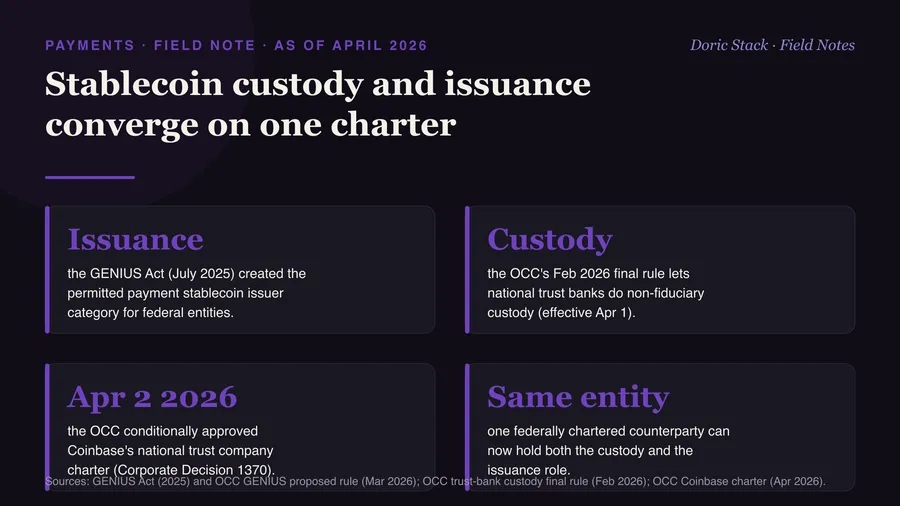
Stablecoin custody and issuance converge on one charter

Stablecoin custody and issuance converge on one charter

Two US regulatory threads just lined up. The GENIUS Act created a federal pathway to issue payment stablecoins, and the OCC's new rule lets national trust banks hold digital assets in non-fiduciary custody - then conditionally chartered Coinbase as one. Issuance and custody can now sit inside the same federally regulated counterparty.

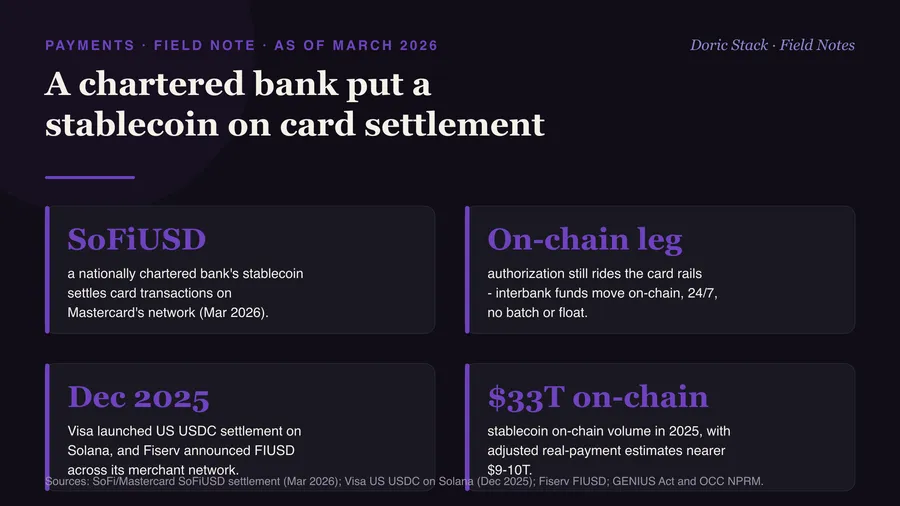
A chartered bank just put a stablecoin on card settlement

A chartered bank just put a stablecoin on card settlement

SoFi Bank put SoFiUSD on Mastercard's settlement layer. Authorization still rides the card rails and the merchant sees nothing change, but the interbank fund movement happens on-chain, around the clock, with no batch window and no correspondent float. For the first time, issuers and acquirers get to choose their settlement medium.