Field note

ACH's most boring 10 characters just became policy

From March 2026, Nacha standardizes the ACH Company Entry Description as PAYROLL or PURCHASE for those payment types. It sounds trivial, but a free-text field becoming a dependable category is what finally lets reconciliation automation stick on a rail that still moves tens of billions of payments a year.

Dec 29, 2025 · Navin Agrawal · Payments · 3 min read

ACH's most boring 10 characters just became policy

Visual brief

Visual brief

ACH's most boring 10 characters just became policy

As of December 2025

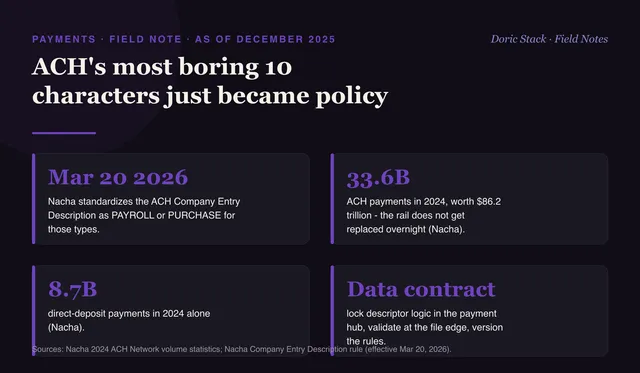
The most boring 10 characters in ACH just got promoted to policy. From March 20, 2026, Nacha requires the Company Entry Description to read PAYROLL or PURCHASE for those payment types.

It sounds trivial. A payroll file clears the window, then a small funding or account mismatch triggers returns and exceptions downstream, and one of the few consistent clues in the trail is that descriptor - too often a generic label like PAYRL_1025. Standardizing it changes how teams monitor, reconcile, and explain cash movement.

Effective

Mar 20 2026

Nacha standardizes the ACH Company Entry Description as PAYROLL or PURCHASE for those payment types.

ACH scale (2024)

33.6B

ACH payments worth $86.2 trillion - the rail does not get replaced overnight (Nacha).

Direct deposit

8.7B

direct-deposit payments in 2024 alone (Nacha).

Why a label is architecture

A reliable category survives the whole journey - from the ERP that originates the file, to bank operations, to the reconciliation engine that has to match it. When PAYROLL means payroll on every file, monitoring and exception workflows can key off it, and the automation that kept slipping on free text finally holds. A messy field becomes a dependable one, and that is the difference between rules that fire and rules that guess.

Why ACH still carries it

This matters because ACH is not going anywhere. In 2024 it moved 33.6 billion payments worth $86.2 trillion, with direct deposit alone at 8.7 billion. Batch fits treasury - predictable reconciliation windows, file-based payroll, known returns. Instant rails need always-on liquidity and staffing many teams do not have yet. The real picture is coexistence, with ACH the default for high-volume predictable flows.
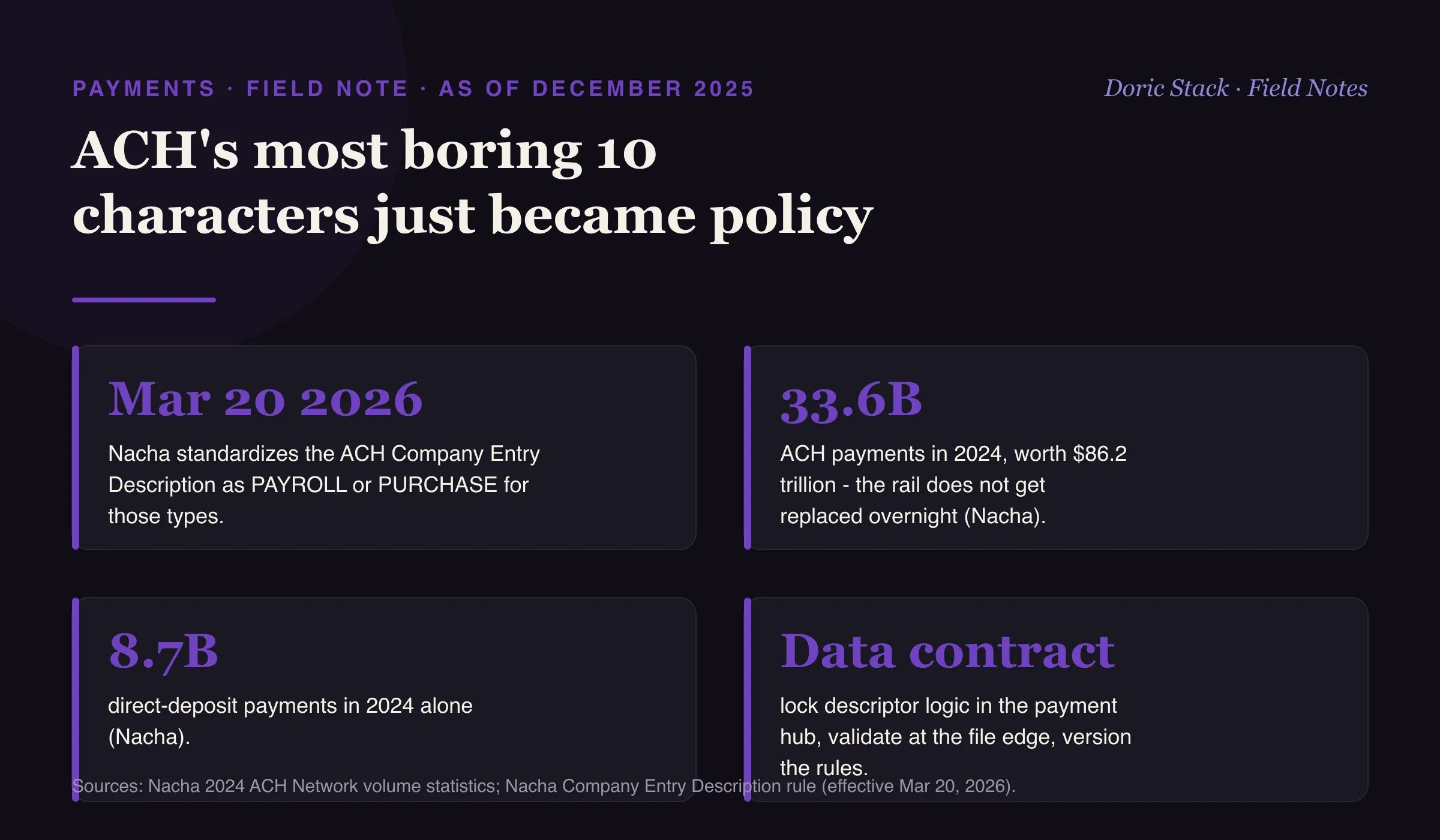
ACH's most boring 10 characters just became policy (as of December 2025): from March 20, 2026 Nacha standardizes the ACH Company Entry Description as PAYROLL or PURCHASE for those payment types; ACH moved 33.6 billion payments worth $86.2 trillion in 2024, so the rail does not get replaced overnight; direct deposit alone was 8.7 billion payments in 2024 (Nacha); and the way to prepare is to treat the descriptor as a data contract - lock the logic in the payment hub, validate at the file edge, and version the rules.
A standardized label survives from ERP to bank ops to reconciliation. That is when reconciliation automation finally sticks.
Descriptors are now architecture, not metadata. When the label becomes reliable, the automation that kept slipping on free text finally holds.
Was this useful?

Choose once.

Related Posts

View All Posts »
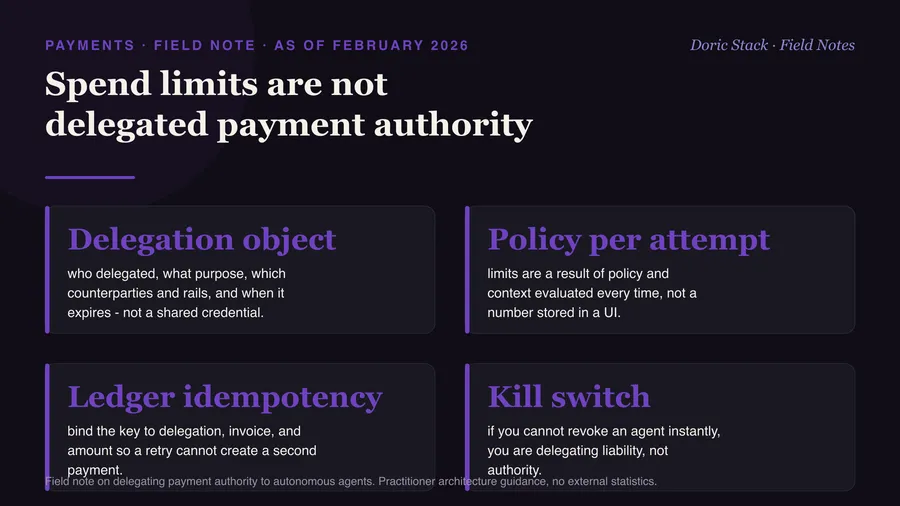
Spend limits are not delegated payment authority

Spend limits are not delegated payment authority

An invoice agent hits a transient timeout, retries, and two payments clear to the same vendor. The model calls it success. Ops calls it a week of cleanup. Spend limits and roles are a speed bump. Real delegated authority is a delegation object, policy on every attempt, ledger-bound idempotency, and an instant kill switch.

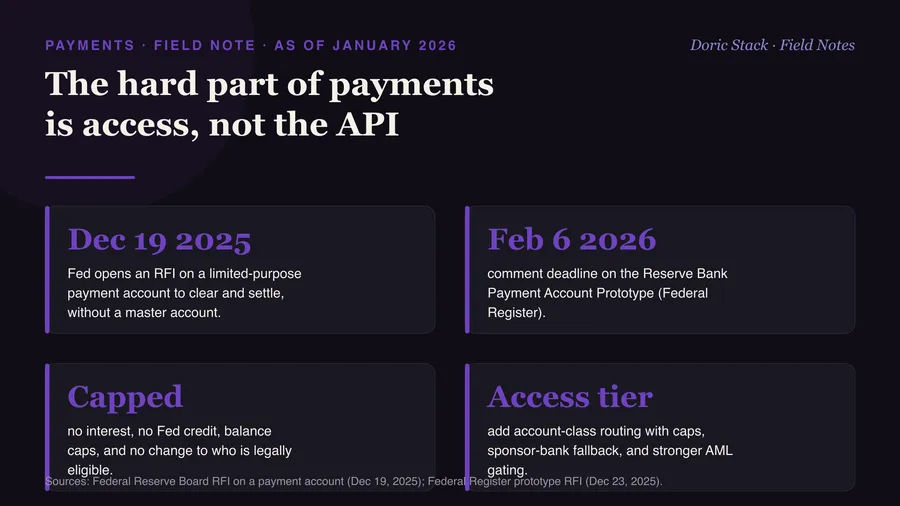
The hard part of payments is access, not the API

The hard part of payments is access, not the API

A payroll rollout taught me the friction is never the integration. It is funding caps, routing permissions, and what can clear directly versus what has to detour through a sponsor bank. That is why the Fed's new payment-account RFI matters - access is becoming a design decision, not just a policy one.

Pay-by-bank's 3% savings hides a reconciliation bill

Pay-by-bank's 3% savings hides a reconciliation bill

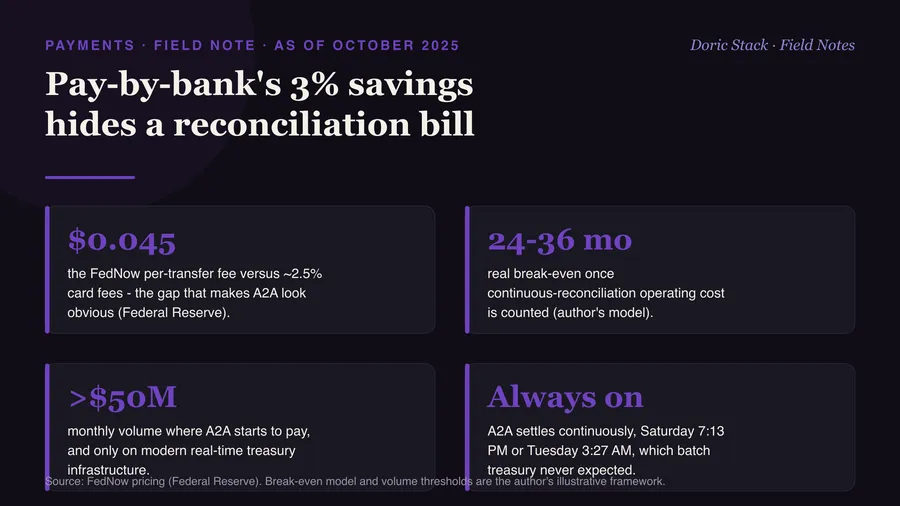
The CFO sees "save 3 percent on transactions" and the math looks obvious. Treasury sees continuous settlement at 3 AM and a reconciliation process built for batch. Before you switch to account-to-account, count the operating cost the savings slide leaves out.

Banks count fraud dollars and miss the exception bill

Banks count fraud dollars and miss the exception bill

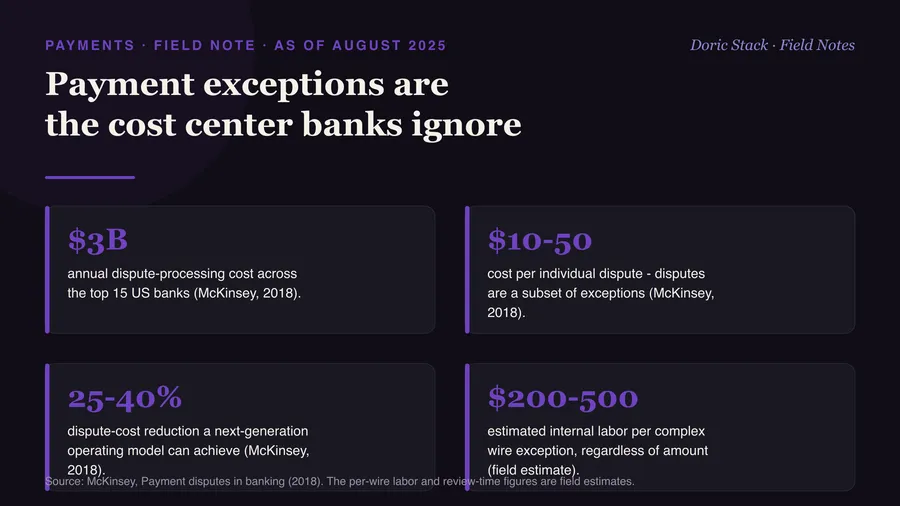
Every failed payment kicks off a chain of manual work that rarely shows up in a fraud dashboard. Across the top 15 US banks, dispute processing alone runs about $3 billion a year - and the wire flagged at $50K costs the same to investigate whether it is real or not.